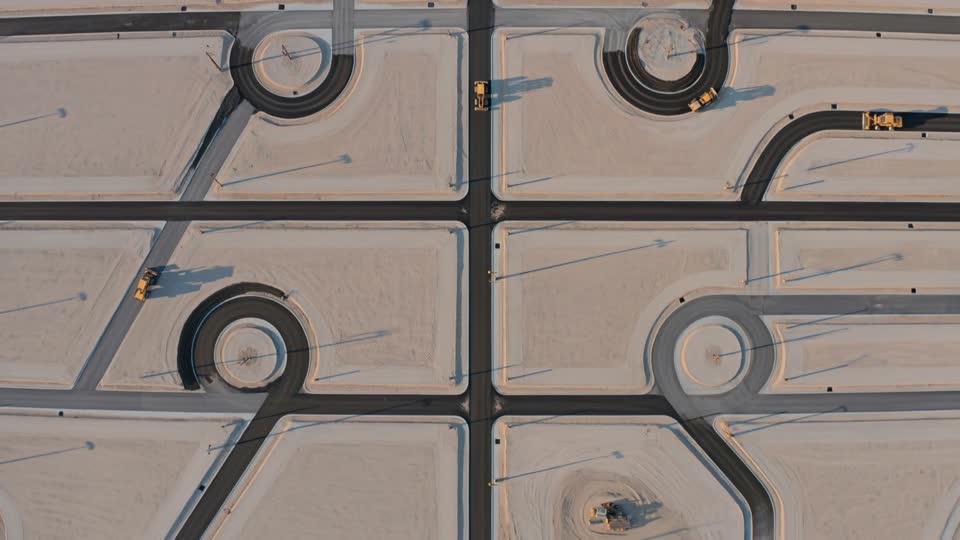
Guide · Sheet G-414
Erosion and sediment control
Erosion and sediment control is the one part of a civil site that has to be finished before the interesting work starts, not after. Silt fence and stabilized entrances installed after the first rain have already missed the point.
Erosion and sediment control (ESC) is not landscaping and it is not an afterthought. It is the set of measures that keep disturbed soil, and the silt it carries, out of storm drains, ditches and watercourses while a site is under construction. The rule on every well-run civil job is the same: ESC goes in before the ground is opened, not after the first rain shows why it was needed.
STA 0+120Why it comes before clearing and stripping
Bare, disturbed soil erodes far faster than vegetated or undisturbed ground, and a civil site creates exactly that condition across its whole working area at once. The standard sequence on a Canadian earthworks job puts silt fence, check dams and stabilized construction entrances in place before clearing and topsoil stripping begin, precisely so the first rain after ground is opened does not carry sediment straight into a storm system or a watercourse. See earthworks and excavation for where ESC sits in the overall sequence, and the site servicing process for how it fits into a subdivision-scale project.
STA 0+240The standard toolkit and what it costs
Alberta Transportation and Economic Corridors' provincial highway tender averages for 2026 give a useful benchmark for the core measures, even though a smaller private site pays more per unit once mobilization and minimum charges are factored in:
| Item | Unit | 2026 avg | Contracts | 2025 | 2024 |
|---|---|---|---|---|---|
| Erosion Control Barrier (Silt Fence)Item E435 | m | $14.30 | 21 | $11.10 | $17.09 |
| Erosion Control Soil Covering - Supply and Install (Type B)Item E505 | m² | $5.89 | 32 | $13.57 | $4.60 |
| Hydro-SeedingItem E609 | ha | $12,582 | 15 | $10,678 | $12,564 |
Silt fence, the erosion control barrier most sites install first, averaged $14.30 per m1 in 2026. Soil covering (Type B) to stabilize an exposed slope averaged $5.89 per m²1, one of three soil-covering types Alberta prices — Type A and Type C cover lighter and heavier-duty applications respectively. Hydro-seeding, used to establish vegetation on disturbed ground quickly, averaged $12,582 per ha1, priced by the hectare rather than by area of fence or blanket because it is a broadcast application over the whole disturbed surface. Other standard measures include erosion control blankets for slopes too steep or too long for seeding alone to hold, and drill or broadcast seeding where hydro-seeding is not specified.
Two other measures round out most ESC plans. A stabilized construction entrance — typically a pad of coarse aggregate at every point equipment leaves the site — exists to knock mud off tires before a truck reaches the public road, and is often the single most visible ESC measure to anyone driving past the site. Inlet protection, a barrier or filter placed directly around a storm catch basin, stops sediment-laden runoff from entering the storm system at the one point it has a direct path to a watercourse, and is usually one of the last things removed once the surrounding area is fully stabilized.
STA 0+360Installation, maintenance, removal
- Install before disturbance. Perimeter silt fence, stabilized construction entrances and any sediment basins go in before clearing or stripping starts.
- Protect as the site opens up. Check dams in ditches, inlet protection at catch basins, and soil covering on stockpiles and exposed slopes go in as each area is disturbed, not all at once at the start.
- Inspect after every significant rain. Silt fence sags, gets undermined or overtops; sediment builds up behind check dams and needs to be removed before it washes past them.
- Stabilize as areas finish. Hydro-seeding or blanket goes down on any area that reaches final grade, rather than waiting for the whole site to be complete.
- Remove temporary measures once vegetation is established, not before, so the site does not lose protection during the gap between construction finishing and permanent cover taking hold.
STA 0+480Permits and plans
Most Canadian municipalities and provinces expect an erosion and sediment control plan as part of a development or construction permit for a site of any real size, showing where measures go, how they will be maintained, and how the site will be stabilized once work is done. Requirements, thresholds and the specific approval process are set locally, so confirming the current requirement with the municipality or provincial regulator for a specific site is worth doing before finalizing a plan, rather than assuming a template from a different jurisdiction applies unchanged.
STA 0+600Where ESC plans actually fail on site
- Installed but not maintained. Silt fence that goes in correctly on day one and is never inspected again is not doing its job by week six.
- Sized for the plan, not the actual disturbed area. A site that expands its working area beyond what the original ESC plan covered needs its controls extended to match, not left at the original footprint.
- Removed too early. Pulling silt fence and blankets as soon as the visible construction work finishes, before vegetation has actually established, leaves a gap exactly when the site is most vulnerable.
- Treated as separate from grading. ESC and lot grading are closely linked: a swale or slope that is regraded after ESC measures are installed can undo the drainage pattern the plan assumed.
See grading, land clearing and retaining walls for the broader discipline, and site preparation cost for how ESC costs typically sit alongside stripping and stabilization in an estimate.
STA 0+720Seasonal timing
ESC measures interact with the same seasonal constraints as the rest of a civil schedule. Vegetation-based stabilization, whether hydro-seeding, drill seeding or broadcast seeding, needs a growing window to actually establish; seed applied late in the season may sit dormant over winter rather than holding a slope through the following spring melt, which is exactly when a site typically sees its heaviest runoff. A site that will carry exposed soil through freeze-up should plan on blanket or another physical stabilization method rather than relying on seed alone to be established in time, and should expect its silt fence and check dams to be doing the real work through spring breakup covered in spring road bans and winter construction. Conversely, a site opened and stabilized entirely within one growing season has an easier job of it: seed applied in spring or early summer, with reasonable moisture, generally establishes well before the site closes out for the year, which is one reason phased construction schedules often try to complete and stabilize one area before opening the next rather than leaving the whole site exposed at once.
Questions people ask
Why does erosion and sediment control go in before clearing starts?
Because bare, disturbed soil erodes far faster than undisturbed ground, and a civil site creates that condition across its whole working area at once. Installing silt fence and stabilized entrances first keeps the first rain after ground is opened from carrying sediment offsite.
How much does silt fence cost?
Alberta’s 2026 provincial average for erosion control barrier (silt fence) on highway tenders is $14.30 per m1, priced by the metre. A small private site typically pays more per metre once mobilization is factored in.
What is hydro-seeding and what does it cost?
A broadcast application that establishes vegetation on disturbed ground quickly, priced by the hectare. Alberta’s 2026 provincial average is $12,582 per ha1.
Do I need an erosion and sediment control plan for a permit?
Most municipalities and provinces expect one for a site of any real size, showing where measures go and how the site will be stabilized. Confirm the current local requirement rather than assuming a template applies.
When should temporary erosion control measures be removed?
Only once permanent vegetation or another stabilization method has actually established, not as soon as visible construction work finishes. Removing controls too early leaves the site unprotected during its most vulnerable period.
What is a stabilized construction entrance for?
A pad of coarse aggregate at every point equipment leaves the site, meant to knock mud and sediment off tires before a truck reaches the public road. It is usually the most visible erosion control measure on a site to anyone passing by.
Sources
- Unit Price Averages (workbook updated 2026-06-24)Alberta Transportation and Economic Corridors · 2026
Related
-
 G-401
Call before you dig
One-call centres by province, notice periods, what the paint means and what to do when marks are missing.
G-401
Call before you dig
One-call centres by province, notice periods, what the paint means and what to do when marks are missing.
-
 G-402
Trench safety & shoring
How deep you can dig without protection in every province, and the sloping, shoring and box rules.
G-402
Trench safety & shoring
How deep you can dig without protection in every province, and the sloping, shoring and box rules.
-
 G-403
Spring road bans
Why thaw closes roads to heavy loads, how Alberta, Saskatchewan, Manitoba and Ontario set them, and how to plan around them.
G-403
Spring road bans
Why thaw closes roads to heavy loads, how Alberta, Saskatchewan, Manitoba and Ontario set them, and how to plan around them.