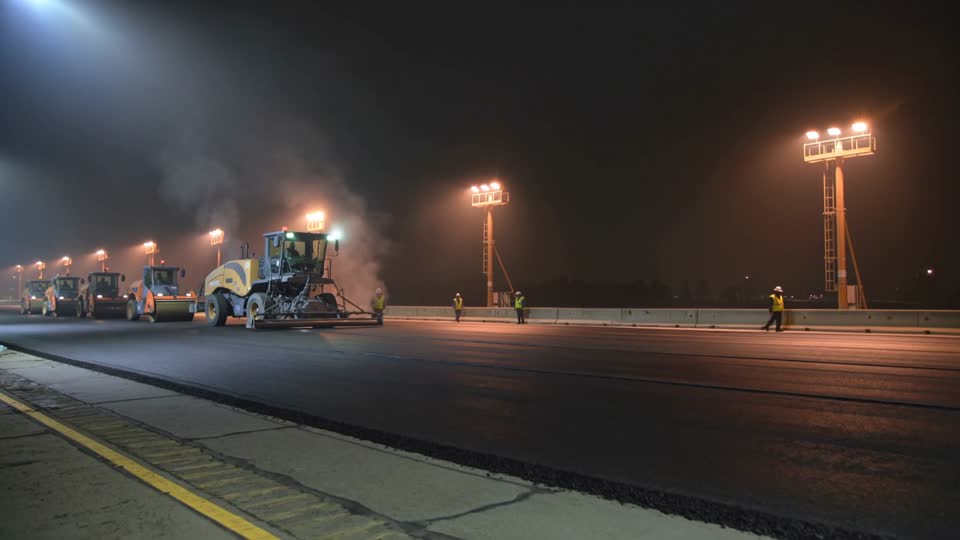
Discipline · Sheet C-104
Roadbuilding and paving
A road is a stack of layers, each doing a different job of spreading load down to the natural ground, and each specified, tested and paid for separately. This is how that stack is built and priced in Canada.
Every paved or gravel road in Canada is built the same way in principle: a prepared subgrade, one or more granular layers to spread traffic load and resist frost, and a wearing surface on top. What changes is the thickness, the material spec and the number of layers, driven by the soil underneath, the traffic the road will carry, and the climate it sits in.
STA 0+120The layers of a Canadian road
From the ground up, a paved road is usually built as:
- Subgrade. The natural or engineered ground, trimmed, compacted and proof-rolled to a uniform surface. See earthworks and excavation for how the bulk grading gets it there.
- Subbase. A lower-quality granular layer, used on weaker subgrades to spread load and improve drainage before the base goes down.
- Base course. A well-graded, compacted crushed granular layer that carries most of the structural load and provides a firm surface to pave on.
- Surfacing. Hot-mix asphalt, a chip or surface treatment, or plain gravel, depending on the traffic volume and budget.
Every layer is compacted and tested before the next one is placed; skipping that step is the most common cause of a road failing years early. See how roads are built for the frost-driven reasoning behind each layer's thickness.
STA 0+240Asphalt mixes and what they cost
Hot-mix asphalt is not one product. Alberta's highway specification alone lists several mix types by aggregate size, gradation and where in the pavement structure they are used, from finer surface courses to coarser lower lifts, plus the newer Superpave mix design method that sizes the mix to the specific traffic and climate of the job. Provincial 2026 averages for the mixes with a published item code:
| Item | Unit | 2026 avg | Contracts | 2025 | 2024 |
|---|---|---|---|---|---|
| Asphalt Concrete Pavement - EPS Mix Type H1Item Q990 | t | $94.50 | 3 | $99.56 | $95.00 |
| Asphalt Concrete Pavement - EPS Mix Type H2Item Q991 | t | $101.80 | 10 | $74.12 | $79.97 |
| Asphalt Concrete Pavement - EPS Mix Type M1Item Q992 | t | $88.90 | 11 | $80.53 | $79.36 |
| Asphalt Concrete Pavement - EPS Mix Type L1Item Q993 | t | $86.88 | 3 | $83.80 | $87.23 |
| Asphalt Concrete Pavement - EPS Mix Type S1Item Q994 | t | $102.61 | 1 | — | — |
| Asphalt Concrete Pavement - EPS Mix Type S3Item Q996 | t | $83.34 | 3 | — | — |
| Asphalt Concrete Pavement - SuperpaveItem Q998 | t | $141.91 | 6 | $85.63 | $129.39 |
Superpave averaged $141.91 per t1 across the contracts tendered, and is increasingly specified in place of the older EPS mix types on higher-traffic routes and municipal arterials; Calgary's own road construction specification, for example, replaced its Marshall Mix 'C' with a 12.5 mm Superpave mix effective February 2025. Asphalt cement (the bitumen binder itself) is priced separately from the mixed product and moves with oil markets: Manitoba Transportation and Infrastructure's own price index for PG58-28 asphalt cement ran from roughly $927 to $1,231 per tonne across 2026, a swing of more than 30% in eight months, which is one reason a paving quote often has a price-adjustment clause tied to an index like this one rather than a flat rate held for the whole season2.
STA 0+360Granular base and gravel surfacing
Granular base course is a crushed, well-graded aggregate compacted to a tight density spec; on Alberta highway contracts, base course averaged $33.65 per t1. Where a road will stay gravel rather than be paved, the top layer is a graded gravel surfacing course rather than a structural base:
| Item | Unit | 2026 avg | Contracts | 2025 | 2024 |
|---|---|---|---|---|---|
| Gravel Surfacing - Des. 4 Cl. 20Item Q185 | t | $54.90 | 4 | — | — |
| Gravel Surfacing - Des. 4 Cl. 25Item Q186 | t | $39.03 | 13 | — | — |
Gravel roads trade a lower first cost for ongoing grading and dust control, and they are common on rural, resource and acreage access roads where paving cannot be justified by the traffic volume. Base and subbase gradations are specified by percentage passing a stack of sieve sizes, not just a maximum stone size, because the fines fraction is what lets the layer compact to a tight, low-permeability density; a gravel that is too clean drains well but never locks together under a roller. See the gravel road cost guide and the gravel and aggregate tonnage calculator.
STA 0+480Milling, seal coats and rehabilitation
Roads are rehabilitated far more often than they are built new. Cold milling removes the top of a worn asphalt surface so a new lift can be placed without raising the road profile or trapping a weak layer underneath; Alberta's two published milling items average $3.09 per m²1 and $4.52 per m²1, the difference reflecting different depths and pass configurations. A seal coat sprays a thin layer of asphalt emulsion and covers it with graded aggregate to seal a cracking surface and restore skid resistance without a full overlay, averaging $4.03 per m²1 on roadways and a higher $24.73 per m²1 on bridge decks, where the deck waterproofing underneath raises the standard of the work. See the asphalt paving cost guide for how milling and overlay pricing compares to a full-depth rebuild.
STA 0+600Markings and roadside safety hardware
A finished road is not complete without pavement markings and, where the roadside geometry calls for it, guardrail. Alberta's standard directional-dividing-and-edge-line painting item averages $1,119 per km1, priced by the kilometre of roadway rather than the metre of paint line, and strong-post W-beam guardrail supply and install averages $169.36 per m1 per metre. Both are typically separate line items from the paving contract itself, sometimes let as their own specialty tender. Markings are painted or laid in thermoplastic depending on the traffic volume and how long the line needs to last between repaints, and guardrail location, post spacing and end-treatment design are set by the road's design speed and roadside hazards, not a single fixed standard applied everywhere.
STA 0+720The state of Canada’s road network
Statistics Canada's Core Public Infrastructure Survey measured Canada's public road network at 1,017,872 two-lane-equivalent kilometres at the end of 20223, with a combined replacement value for roads, bridges, tunnels and active transportation infrastructure of $1.63 trillion4. Of the road asset inventory, 14.8% was rated poor or very poor condition5, representing about $250.2 billion of replacement value4. Separately, Statistics Canada's national accounts model puts the average age of highway and road structures at 10.8 years with just over half their useful service life remaining6. Renewal and rehabilitation, not new construction, make up a large and growing share of roadbuilding work as a result.
STA 0+840Frost, spring road bans and cold-weather paving
Frost governs both when a road can be built and how much it can carry once built. Every Prairie province and Ontario imposes spring weight restrictions on trucks while the ground thaws from the surface down and loses bearing strength: Alberta's provincial road bans are weather-dependent and keyed to a thaw depth of at least 25 cm7, Saskatchewan's 2026 restrictions cut allowable weights on secondary highways and rural roads by 10 to 15%8, Manitoba's Level 1 restriction caps axle-group weights at 90% of the legal limit9 (Level 2 drops to 65%9), and Ontario limits a single axle to 5,000 kg on a designated highway during its reduced load period10. See spring road bans for how each province sets and lifts them, and winter construction for what paving in cold weather adds to a schedule and a price.
STA 0+960What to send for a price
A paving or roadbuilding quote firms up fastest when the brief includes:
- The area, length and lane configuration, or the existing pavement condition if this is a rehabilitation.
- Design thickness for each layer, or the traffic loading if the pavement structure is not yet designed.
- Whether the existing surface needs milling, full removal or can be overlaid directly.
- Access, working hours and any load restrictions that apply to the haul routes in.
- The schedule, including whether it needs to land before a spring road ban or before cold weather sets in.
- Whether markings, guardrail or other roadside hardware are in scope.
Ask whether the asphalt price is fixed or adjusts with a cement or fuel index, how milled material and any surplus granular are handled, and who owns the risk of a subgrade that turns out weaker than assumed. Those answers predict most disputes on a paving job.
Questions people ask
How many layers does a paved road have?
Most Canadian roads have a prepared subgrade, one or two granular layers (subbase and base), and a surfacing layer of hot-mix asphalt, a surface treatment, or gravel. Weaker soils and higher traffic volumes generally mean more, or thicker, granular layers. See how roads are built.
What is cold milling?
Why do roads have weight restrictions in spring?
As frozen ground thaws from the surface down, water is trapped above the still-frozen layer below, and the road structure temporarily loses much of its bearing strength. Provinces respond with seasonal weight restrictions on trucks until the whole depth has thawed and drained. See spring road bans.
What is a seal coat?
A seal coat sprays a thin film of asphalt emulsion over an existing surface and covers it with graded aggregate, sealing small cracks and restoring skid resistance without the cost of a full overlay. It extends pavement life but does not add structural strength.
How much does asphalt paving cost per tonne?
On Alberta provincial highway contracts in 2025–26, Superpave asphalt averaged $141.91 per t1, with the older EPS mix types generally lower. Municipal and small commercial paving costs more per tonne because mobilization and minimum charges are spread over less material. See the asphalt paving cost guide.
What is Superpave?
Superpave is an asphalt mix design method that selects the binder grade and aggregate structure to match a specific road’s traffic level and climate, rather than using one standard recipe for every job. It has been replacing older mix-type systems on higher-traffic Canadian roads.
Sources
- Unit Price Averages (workbook updated 2026-06-24)Alberta Transportation and Economic Corridors · 2026
- Asphalt Cement Price IndexManitoba Transportation and Infrastructure · 2026
- Table 34-10-0287-01 Inventory of core public infrastructure assetsStatistics Canada · 2022 ref year; released 2025-02-04
- The Daily - Canada's Core Public Infrastructure Survey: Replacement values, 2022Statistics Canada · 2022-12-31
- Table 34-10-0288-01 Inventory distribution of core public infrastructure assets by physical condition ratingStatistics Canada · 2022 ref year; released 2025-02-04
- Table 36-10-0611-01 Infrastructure Economic Accounts, average age and remaining useful service life ratio by asset and asset functionStatistics Canada · 2025; released 2026-06-12
- Road restrictions and bansGovernment of Alberta · retrieved 2026-09-24
- Secondary Highways in Southern Saskatchewan to Begin Spring Weight Restrictions Friday to Protect InfrastructureGovernment of Saskatchewan · 2026-03-19
- Manitoba's Spring Road Restriction (SRR) ProgramGovernment of Manitoba · retrieved 2026-09-24
- Highway Traffic Act, R.S.O. 1990, c. H.8, s. 122 Reduced load periodsGovernment of Ontario (e-Laws) · current to 2026-09-21
Related
-
 C-101
Earthworks & excavation
Stripping, bulk excavation, cut and fill, rock, compaction and the volumes that drive every estimate.
C-101
Earthworks & excavation
Stripping, bulk excavation, cut and fill, rock, compaction and the volumes that drive every estimate.
-
 C-102
Site servicing & land development
Water, sewer, storm and roads for new lots, and the agreements, levies and sequence that come with them.
C-102
Site servicing & land development
Water, sewer, storm and roads for new lots, and the agreements, levies and sequence that come with them.
-
 C-103
Underground utilities
Watermain, sanitary and storm sewer, manholes and services, from trench design to testing.
C-103
Underground utilities
Watermain, sanitary and storm sewer, manholes and services, from trench design to testing.