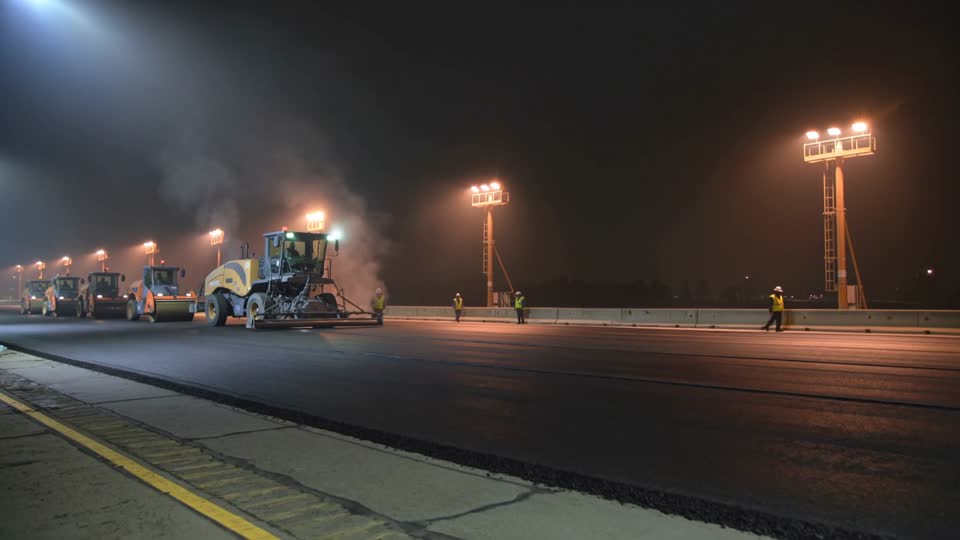
Guide · Sheet G-411
How roads are built in Canada
A road is a sandwich, not a slab. Every layer under the asphalt exists to spread a wheel load out and keep water and frost from breaking the layer above it, and the mix of layers a Canadian road needs is set as much by the local frost depth as by the traffic it carries.
Cut a Canadian road in cross-section and it is a stack of purpose-built layers, not one uniform material. The native ground is prepared as subgrade, granular layers spread the load and drain water, and asphalt or concrete forms the wearing surface that actually carries traffic. How thick each layer is depends on the traffic the road will carry and, in most of Canada, on how deep the ground freezes each winter.
STA 0+120The layers, top to bottom
- Surface course. Hot-mix asphalt or concrete pavement, the layer that actually carries wheel loads and weather.
- Base course. A dense, well-graded granular layer directly under the surface, engineered to spread load and resist rutting.
- Subbase. A coarser granular layer below the base, often using a lower-cost aggregate, that continues spreading load down toward the subgrade and helps drain water out of the structure.
- Subgrade. The prepared native soil, or engineered fill, that the whole structure sits on. Its strength and drainage set how thick everything above it needs to be.
See roadbuilding and paving for the discipline overview and aggregates and gravel for how base and subbase materials are specified and supplied.
STA 0+240Subgrade: everything starts here
A road is only as good as the ground it sits on. Subgrade preparation means compacting the native soil (or engineered fill, where the native material is unsuitable) to a specified density, proof-rolling it to find soft spots, and correcting anything that deflects excessively under a loaded roller before granular material goes on top. A subgrade that is not properly prepared telegraphs its problems upward: a soft spot that was not found and fixed at subgrade shows up later as a rut or a crack in the finished surface, often long after the contractor who built it has left the job. See earthworks and excavation for how subgrade preparation fits into the broader earthworks sequence.
STA 0+360Base and subbase: the granular structure
The granular base and subbase do the load-spreading work of a road structure. Alberta's 2026 provincial average price for a well-graded Design 2, Class 25 granular base course is $33.65 per t1, measured by the tonne rather than by area or volume, because gradation and compaction, not just thickness, are what make the material perform. A thicker, better-specified granular structure allows a thinner and less expensive surface course above it, which is part of why pavement design is an engineering trade-off between granular depth, surface thickness and expected traffic, not a fixed formula. Nationally, the earthwork-related division of Statistics Canada's non-residential Building Construction Price Index stood at 111.4 (2023=100) in Q2 2026, up 3.4% from a year earlier — a general cost-trend signal for the subgrade and granular stage of a road project, not a road-specific index2.
| Item | Unit | 2026 avg | Contracts | 2025 | 2024 |
|---|---|---|---|---|---|
| Granular Base Course - Des. 2 Cl. 25Item B282 | t | $33.65 | 26 | $29.03 | $32.51 |
| Preparing Subgrade Surface (First Layer)Item B180 | m² | $2.03 | 21 | $1.56 | $2.32 |
STA 0+480The surface: asphalt or concrete
Hot-mix asphalt is the default surface for most Canadian roads, priced and specified by mix type. Alberta's 2026 provincial average for an EPS mix type M1 asphalt concrete pavement is $88.90 per t1, one of several standard mix types the province uses depending on traffic loading and layer position. Concrete pavement is used where a longer design life or specific loading conditions justify the higher initial cost, priced by area rather than by tonne. Either surface still depends entirely on the granular structure underneath performing as designed; a strong asphalt mix laid over an under-built base course will not hold up regardless of how well the asphalt itself was placed.
STA 0+600Why frost drives the design
In most of Canada, the ground freezes every winter, and frost-susceptible soils (fine-grained soils that hold water) can heave as ice lenses form and grow, and then lose strength as they thaw. A pavement structure has two basic strategies for dealing with this: build the granular structure deep enough that the frost-susceptible subgrade below it is either not disturbed by traffic loading during the thaw, or design for the seasonal loss of strength directly, which is part of why several provinces apply spring road bans rather than building every road to carry full legal loads through the thaw. A pavement designed for a colder, higher-frost-depth region genuinely needs a different granular thickness than the same traffic volume would need in a milder part of the country.
STA 0+720A specification changing in real time: Calgary’s Superpave shift
Specifications are not static. The City of Calgary's Standard Specifications for Road Construction date to a 2021 edition, but Bulletin 2025-01 replaced Marshall Mix "C" with a 12.5 mm Superpave mix effective February 25, 20253. Superpave is a performance-based asphalt mix design method rather than the older Marshall method, and the change is a reminder that a design based on an older bulletin or a neighbouring municipality's specification can be out of date even when the base specification document's cover year has not changed. Confirm the current bulletin, not just the edition year, before finalizing a paving design.
STA 0+840A subdivision road vs a provincial highway
The same layered logic applies at very different scales. A provincial highway is engineered for high-speed, high-volume truck traffic and often built to decades-long design life, while a subdivision or municipal road is engineered for local traffic and a municipality's own standard cross-section, which is usually thinner and uses different granular and surface specifications entirely. See municipal infrastructure for how cities specify and renew their own road networks, and the site servicing process for how a new subdivision's roads get designed, approved and built.
STA 0+960Roads without asphalt
Not every Canadian road gets a paved surface, and the layered logic still applies to the ones that do not. A gravel or lease road skips the asphalt or concrete surface course entirely, relying on a well-graded granular surfacing layer, proper crown and ditching to shed water, and periodic grading maintenance to keep the running surface intact. These roads still need subgrade preparation and a subbase where traffic loading or soil conditions call for it; the difference from a paved road is mainly in what carries the wheel load directly — compacted gravel instead of a bound asphalt or concrete mat — and that trade-off shows up in both the lower upfront construction cost and the higher ongoing grading and maintenance cost a gravel surface needs over its working life. See gravel road cost for pricing and aggregates and gravel for how surfacing gravel is specified and supplied.
Questions people ask
What are the layers of a road?
From the bottom up: prepared subgrade, a subbase of coarser granular material, a denser granular base course, and a surface course of asphalt or concrete. Each layer spreads load and manages water for the layer above it.
Why does frost affect road design in Canada?
Frost-susceptible soils can heave as ice forms in winter and lose strength as they thaw in spring. Roads are designed with enough granular depth to manage this, and several provinces apply spring weight restrictions rather than build every road for full legal loads year-round; see spring road bans.
How much does granular base course cost?
Alberta’s 2026 provincial average for Design 2, Class 25 granular base course is $33.65 per t1, priced by the tonne based on gradation and compaction, not just depth.
What is Superpave?
A performance-based asphalt mix design method. Under Calgary’s 2021-edition road construction specification, Bulletin 2025-01 replaced the older Marshall Mix "C" with a 12.5 mm Superpave mix, effective February 25, 20253.
How is a subdivision road different from a highway?
Both use the same layered structure, but a highway is built for higher-speed, higher-volume truck traffic and a longer design life, while a municipal or subdivision road follows that city’s own, generally thinner, standard cross-section.
Sources
- Unit Price Averages (workbook updated 2026-06-24)Alberta Transportation and Economic Corridors · 2026
- Table 18-10-0289-01 Building construction price indexes, by type of building and divisionStatistics Canada · Q2 2026 (April 2026 reference); released 2026-07-24
- Road contractors and consultantsCity of Calgary · retrieved 2026-09-24
Related
-
 G-401
Call before you dig
One-call centres by province, notice periods, what the paint means and what to do when marks are missing.
G-401
Call before you dig
One-call centres by province, notice periods, what the paint means and what to do when marks are missing.
-
 G-402
Trench safety & shoring
How deep you can dig without protection in every province, and the sloping, shoring and box rules.
G-402
Trench safety & shoring
How deep you can dig without protection in every province, and the sloping, shoring and box rules.
-
 G-403
Spring road bans
Why thaw closes roads to heavy loads, how Alberta, Saskatchewan, Manitoba and Ontario set them, and how to plan around them.
G-403
Spring road bans
Why thaw closes roads to heavy loads, how Alberta, Saskatchewan, Manitoba and Ontario set them, and how to plan around them.