Discipline · Sheet C-103
Underground utilities
Watermain, sanitary sewer and storm drainage are the pipes a city cannot function without, and almost all of them are buried in a trench that has to be dug, bedded, backfilled, tested and, on a city street, put back the way it was found.
Three pipe networks run under most Canadian streets: a pressurized watermain delivering drinking water, a gravity sanitary sewer carrying wastewater to treatment, and a storm sewer moving rainwater and snowmelt to a pond, creek or river. They are designed, bedded and tested differently because they do different jobs, but they usually share the same trench, the same contractor and the same inspection window.
STA 0+120What underground utilities covers
On a typical municipal or subdivision job, the underground utilities scope breaks into:
- Watermain. Pressure pipe, valves, hydrants and services, tied into the existing distribution system at one or more points and pressure-tested before it goes into service.
- Sanitary sewer. Gravity pipe laid to a continuous fall between manholes, sized and sloped so wastewater moves by gravity alone to a trunk line or lift station.
- Storm sewer. Gravity pipe and catch basins collecting surface runoff, increasingly paired with a pond or underground storage tank to control the rate of discharge.
- Manholes and structures. Precast concrete risers and bases at every junction, grade change and maintenance access point.
This page covers how the pipe itself is trenched, bedded and tested. For the roads it runs under, see roadbuilding and paving; for the approvals and levies that come before it, see site servicing and land development; for boring under a road instead of trenching it, see trenchless and directional drilling.
STA 0+240Trench design: bedding, cover and backfill
A pipe trench is built in layers, and each one has a job:
- Foundation. Undisturbed or re-compacted native ground below the bedding, sometimes replaced with a granular pad over soft or wet soil.
- Bedding. A layer of clean, compactable granular material under and around the pipe (the pipe zone) that supports the barrel evenly and lets it deflect slightly under load without cracking.
- Initial backfill. Placed and compacted in lifts to a specified height over the crown before heavier material or equipment is allowed over the pipe.
- Final backfill. The remainder of the trench up to subgrade or finished grade, compacted to the standard the road or landscaping above it requires.
Trench width, wall support and safe access are governed by occupational health and safety law, not the pipe specification: see trench safety and shoring for the depth thresholds and shoring rules in every province. The trench excavation calculator and pipe bedding and backfill calculator turn a pipe run and trench section into cubic metres and tonnes.
STA 0+360Manholes, catch basins and connections
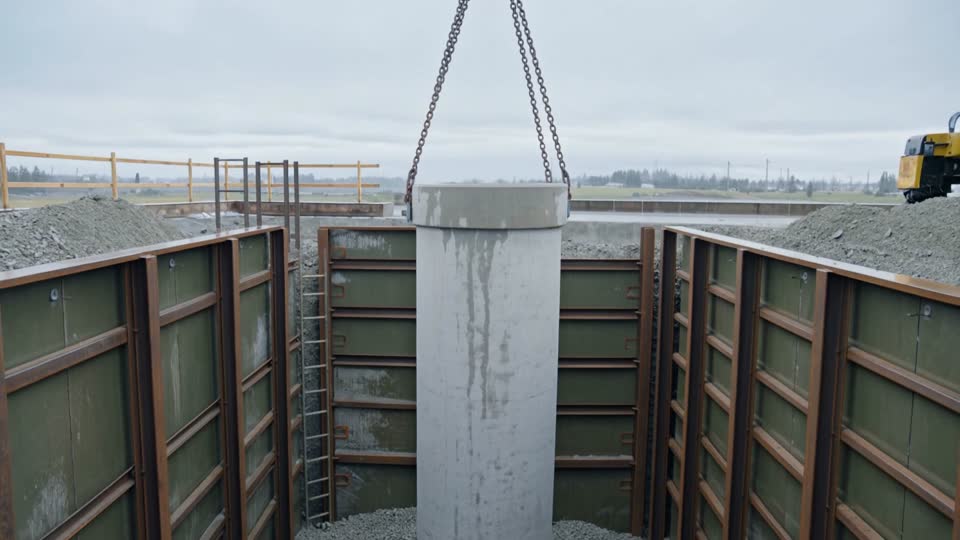
Manholes and catch basins are usually precast off site and lowered into the trench by crane, then jointed and benched by hand. A few recurring pay items describe the work that surrounds them on an Alberta highway contract: a standard catch basin supply and install runs about $8,389 per unit1, and adjusting an existing manhole, catch basin or water valve to match a new road surface (after an overlay, for example) is priced separately, because it is common maintenance work in its own right rather than new construction.
Service connections, or leads, run from the main to the property line and are priced by the metre; on Alberta highway work they average $524.59 per m1. In a subdivision, the lead is usually stubbed in during main construction so the builder only has to connect at the property line later.
STA 0+480How new pipe is tested before it is accepted
A municipality will not accept a new pipe on trust. Before final acceptance:
- Watermain is hydrostatically pressure-tested to check for leaks and disinfected (chlorinated and flushed) before it can carry drinking water.
- Gravity sanitary and storm sewer is checked for line and grade, then typically low-pressure air-tested or vacuum-tested for leaks, and inspected by a mandrel (to catch pipe deflection) and closed-circuit television (to catch debris, joint offsets or damage).
- Manholes are usually vacuum-tested to confirm the joints and frame are sealed.
Standards for each test (pressure, duration, allowable leakage) come from the municipality's own construction specification, which is why the same pipe material can be tested differently in two neighbouring cities.
STA 0+600The locate colour code
Before any excavation, the utilities in the work area are marked on the ground in a standardized colour code so every trade reads the same paint the same way:
| Colour | What it marks |
|---|---|
| 2 | Electric power lines, cables, conduit and lighting cable |
| 2 | Gas, oil, steam or other gaseous or petroleum material |
| 2 | Communication, alarm or signal lines, cables or conduit |
| 2 | Potable water |
| 2 | Sewers and drain lines |
| 2 | Temporary survey markings |
| 2 | Reclaimed water, irrigation and slurry lines |
| 2 | Proposed excavation |
Alberta's Utility Safety Partners publishes a matching colour sheet (2022) used across the province3. The paint tells a machine operator what is buried, not exactly how deep or how far off the marked line the tolerance zone extends; the excavator still has to hand-expose before digging mechanically close to a mark. See call before you dig for notice periods and how to request a locate.
STA 0+720Why so much of this work is renewal, not new construction
Canada's underground pipe network is enormous and much of it is old. Statistics Canada's Core Public Infrastructure Survey counted 221,532 km of publicly owned potable water pipe and 164,048 km of wastewater pipe (sewers and forcemains) at the end of 202244, alongside 526,628 km of linear stormwater assets including ditches4. About 14.3% of the water pipe inventory and 12.5% of the wastewater pipe inventory were rated poor or very poor condition55, and Canada installed about 29,100 km of new pipe between 2020 and 2022, an average of roughly 9,700 km a year6. Water infrastructure alone carries a replacement value of roughly $963 billion6. A significant and growing share of underground utilities work is replacing or relining what is already there, not extending the network into new subdivisions.
STA 0+840Restoring the surface after the trench
On an urban street, the trench is only half the job; the surface has to be reinstated to the city's standard, and the city usually charges a permit fee to cover its own inspection and long-term degradation of the pavement. Calgary's excavation permit rate sheet charges an asphalt degradation fee that varies by road classification, from about $49.95/m² on a local street to $61.15/m² on an arterial road, on top of the direct cost of the trench and patch itself7. Winnipeg charges a flat minimum plus an area rate for pavement cut restoration, with separate rates for sidewalk and curb cuts8. These are city-set administrative charges, not contractor bid prices, and they are easy to forget when pricing a small utility cut in a paved street.
STA 0+960What underground utilities cost: 2026 Alberta benchmarks
Alberta Transportation and Economic Corridors publishes the average of the three lowest bids on every pipe, structure and adjustment item it tenders on the provincial highway system. For contracts tendered between May 2025 and June 2026:
| Item | Unit | 2026 avg | Contracts | 2025 | 2024 |
|---|---|---|---|---|---|
| Concrete Storm Sewer - Supply and InstallItem D787 | m | $494.69 | 1 | — | — |
| Catch Basin - Supply and Install (600 mm dia. x 1.83 m)Item D760 | unit | $8,389 | 2 | — | — |
| Adjust ManholeItem D732 | unit | $998.34 | 3 | — | — |
| Adjust Catch BasinsItem D733 | unit | $5,103 | 1 | — | — |
| Adjust Water ValveItem D734 | unit | $838.61 | 4 | — | — |
| Leads - Supply and InstallItem D795 | m | $524.59 | 2 | — | — |
These are highway-scale averages on large contracts, with the excavation, bedding and backfill priced as separate items elsewhere in the same tender. A small urban utility cut costs more per metre because it is fighting traffic control, a narrow work zone and the city's own restoration and inspection fees. The watermain and sewer replacement cost guide and the unit price index carry the full item list.
STA 1+080What to send for a price
Underground utilities are priced from a design, not a guess, because pipe size, depth, bedding class and manhole spacing all change the number. A complete brief usually includes:
- Drawings showing pipe size, material, depth and grade, or at minimum the run length and rough depth if no design exists yet.
- Soil and groundwater information, since dewatering and shoring both change with the water table.
- The point of connection to the existing system and any known conflicts nearby.
- Whether locates have been requested and whether private lines are known to cross the alignment.
- Road classification and traffic control requirements if the work is in a live street.
- The testing and inspection standard the owner will apply at acceptance.
Ask how the trench will be measured for payment, what happens if rock or unsuitable soil is found at pipe grade, and who owns the risk of an unmarked utility conflict. Those three answers predict most disputes on an underground utilities job.
Questions people ask
How deep are sanitary sewer lines?
Depth is set by the gravity grade needed to reach the connection point, not by a single rule, so it varies run by run and city by city. A sewer still has to clear the frost zone and any conflicting utility it crosses; the design drawings for the specific street are the only reliable source for depth, not a rule of thumb.
What is pipe bedding and why does it matter?
Bedding is the layer of clean, compactable granular material placed under and around a pipe so the load from the backfill and road above is carried evenly along the barrel. Without it, a rigid pipe can crack and a flexible pipe can deflect out of round. See the pipe bedding and backfill calculator.
What do the colours in utility locate paint mean?
Canada uses a common colour code: red for electrical, yellow for gas and other petroleum products, orange for communications, blue for potable water, green for sewers and drains, purple for reclaimed water and slurry lines, pink for temporary survey marks, and white for the proposed excavation area. See call before you dig for how to request a locate.
How is a new sewer tested before a city accepts it?
Gravity sewers are typically checked for line and grade, then air- or vacuum-tested for leaks, with a mandrel run through to catch out-of-round pipe and a camera inspection to catch debris, offset joints or damage. Watermain is pressure-tested and disinfected before it can be put into service. The exact test parameters come from the municipality’s own specification.
Who pays to restore the road after a utility cut?
The party that opened the street pays. Most cities charge a restoration or degradation fee on top of the contractor’s own patch, to cover long-term wear on the pavement and the city’s inspection: Calgary and Winnipeg both publish city-set rate sheets for this separate from any contractor bid price.
Why does adjusting a manhole cost so much?
Adjusting a manhole, catch basin or valve box to a new road surface (after an overlay, for example) involves breaking out the old frame, resetting risers to the new grade, and re-sealing the joint, all inside a live traffic lane. On Alberta highway contracts it is priced as its own item because it is common maintenance work, not incidental to new construction.
Sources
- Unit Price Averages (workbook updated 2026-06-24)Alberta Transportation and Economic Corridors · 2026
- CCGA Best Practices Version 3.0 (October 2018), uniform colour code (page 41)Canadian Common Ground Alliance · Best Practices v3.0, Oct 2018 (a v5.0 was reported released in 2024; not checked)
- Colour Code ExplanationUtility Safety Partners · 2022 (from search excerpt)
- Table 34-10-0287-01 Inventory of core public infrastructure assetsStatistics Canada · 2022 ref year; released 2025-02-04
- Table 34-10-0288-01 Inventory distribution of core public infrastructure assets by physical condition ratingStatistics Canada · 2022 ref year; released 2025-02-04
- The Daily - Canada's Core Public Infrastructure Survey: Replacement values, 2022Statistics Canada · 2020-2022
- Excavation Permit Rate SheetCity of Calgary (Roads) · 2026
- Pavement Cut Restoration FeesCity of Winnipeg Public Works · 2026
Related
-
 C-101
Earthworks & excavation
Stripping, bulk excavation, cut and fill, rock, compaction and the volumes that drive every estimate.
C-101
Earthworks & excavation
Stripping, bulk excavation, cut and fill, rock, compaction and the volumes that drive every estimate.
-
 C-102
Site servicing & land development
Water, sewer, storm and roads for new lots, and the agreements, levies and sequence that come with them.
C-102
Site servicing & land development
Water, sewer, storm and roads for new lots, and the agreements, levies and sequence that come with them.
-
 C-104
Roadbuilding & paving
How Canadian roads are built layer by layer, and what drives paving, milling and rehabilitation costs.
C-104
Roadbuilding & paving
How Canadian roads are built layer by layer, and what drives paving, milling and rehabilitation costs.