Discipline · Sheet C-107
Trenchless construction and directional drilling
Trenchless methods install or renew a pipe or conduit without digging a continuous open trench along its length: a narrower entry and exit pit, or none at all, and everything in between happens underground.
Trenchless work covers two different jobs: installing new pipe or conduit under an obstacle without opening a trench across it, and renewing an existing pipe from the inside without digging it up at all. Both trade a higher price per metre for avoiding the cost, disruption and restoration of an open cut.
STA 0+120The main trenchless methods
Five methods cover most trenchless work in Canadian civil construction:
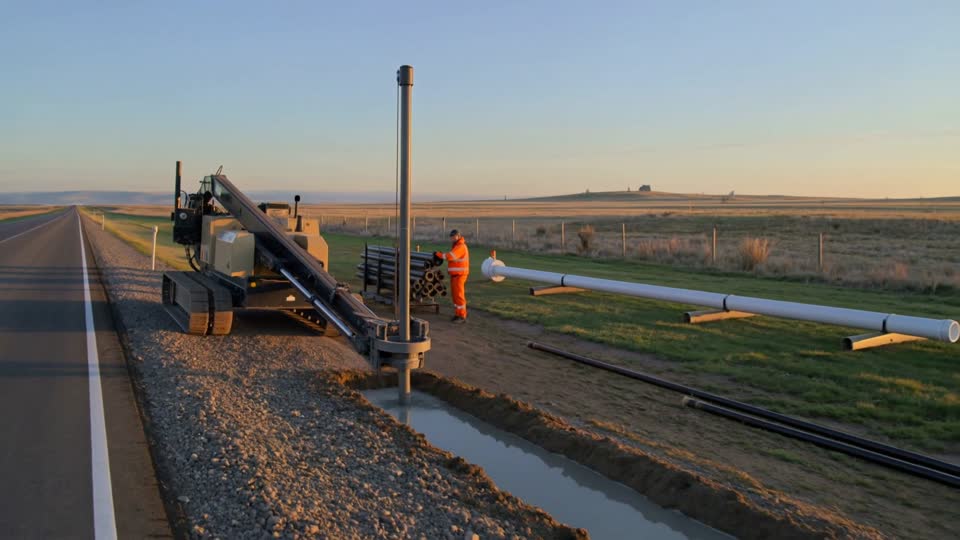
- Horizontal directional drilling (HDD). A steerable drill bores a pilot hole along a planned path, then the hole is reamed to size and a pipe is pulled back through it.
- Auger boring. A rotating auger inside a steel casing bores straight ahead from a launch pit, jacking the casing in behind it; simple and effective for short, straight crossings.
- Microtunnelling. A remote-controlled tunnel boring machine advances a pipe by jacking, guided continuously to line and grade; used for larger diameters and where grade accuracy matters, such as a gravity sewer.
- Pipe bursting. A bursting head is pulled through an existing pipe, fracturing it outward into the surrounding soil while a new pipe is pulled in behind it, replacing the old pipe on the same alignment.
- Cured-in-place pipe (CIPP) lining. A resin-saturated liner is inserted into an existing pipe and cured in place, forming a new pipe-within-a-pipe without removing the old one.
See underground utilities for how the same pipe is designed and bedded when it is installed by open trench instead.
STA 0+240Horizontal directional drilling
HDD runs in three stages: a pilot bore follows a planned path (typically a shallow arc down, along, and back up) tracked by a locator on the surface; the hole is then enlarged by one or more reaming passes; and finally a pre-assembled length of pipe, usually fused HDPE, is pulled back through the reamed hole in one continuous piece. The result is a pipe with no joints along the bored length, installed without disturbing the surface above except at the entry and exit pits.
HDD is the standard choice for crossing a road, rail line, waterway or environmentally sensitive area where an open trench is impractical or not permitted. Drilling fluid (usually a bentonite slurry) lubricates the bore and carries cuttings back to the surface, and managing that fluid, rather than the drilling itself, is often what limits production on a real job.
STA 0+360Auger boring and microtunnelling
Auger boring pushes a steel casing straight through the ground from a launch pit to a reception pit, using an auger inside the casing to remove spoil as it advances. It is simple, well understood and commonly used for short, straight road and rail crossings where line and grade tolerance is forgiving.
Microtunnelling does the same basic job with far more precision: a remote-controlled tunnel boring machine is steered continuously against a laser guidance system, jacking pipe behind it to a tight line and grade tolerance. That precision is what makes it suitable for gravity sewers, which have to fall continuously to keep flowing, and for larger-diameter crossings under sensitive infrastructure where a boring machine's deviation has to be caught and corrected in real time rather than found after the fact.
STA 0+480Pipe bursting and CIPP lining: renewing pipe without digging it up
Pipe bursting and CIPP lining both renew a pipe that is already in the ground, which is why they matter so much for aging municipal networks. Pipe bursting is used where the pipe's capacity needs to increase (bursting allows a same-size or slightly larger replacement pipe to be pulled in) or where the existing pipe is too degraded to line. CIPP lining is used where the existing pipe's structure is basically sound but its interior has corroded, cracked or lost capacity to root intrusion or infiltration; the cured liner restores a smooth interior and seals infiltration points without the excavation, traffic control and restoration cost of digging the street back up.
Both methods still need access points, typically existing manholes or purpose-dug pits at intervals, so "trenchless" means no continuous trench, not no excavation at all.
STA 0+600Trenchless culvert rehabilitation
A deteriorated culvert can often be relined instead of dug out and replaced, sliding a new liner pipe inside the old one and grouting the annular space between them. Alberta's highway price averages for culvert liner supply and install:
| Item | Unit | 2026 avg | Contracts | 2025 | 2024 |
|---|---|---|---|---|---|
| Culvert Liner - Supply and Install (600 mm Dia.)Item D840 | m | $1,301 | 1 | — | — |
| Culvert Liner - Supply and Install (750 mm Dia.)Item D845 | m | $1,273 | 1 | — | — |
| Culvert Liner - Supply and Install (S.W.S.P.)Item D850 | m | $1,262 | 3 | — | — |
Grouting the space behind the liner, or grouting an old culvert being abandoned in place rather than removed, is priced separately by the cubic metre:
| Item | Unit | 2026 avg | Contracts | 2025 | 2024 |
|---|---|---|---|---|---|
| Grouting of Abandoned CulvertsItem D540 | m³ | $759.00 | 18 | $635.21 | $758.96 |
| Grouting Liners (Plastic Pipe)Item D545 | m³ | $701.33 | 1 | — | — |
| Grouting Liners (S.W.S.P)Item D546 | m³ | $919.79 | 3 | — | — |
Lining trades some of the culvert's original flow capacity, since the new liner sits inside the old barrel, for avoiding the cost, traffic disruption and environmental permitting of excavating and replacing a culvert under an active road. See culvert installation cost for full replacement pricing by comparison.
STA 0+720Trenchless versus open trench: what the premium buys
Trenchless methods almost always cost more per metre than open trenching for the same pipe. Alberta's own highway price averages for underground electrical conduit make the comparison directly: pushed (trenchless) conduit averaged $149.03 per m1, against $69.87 per m1 for the same conduit installed by trench excavation, a difference of more than double per metre. That premium buys no open cut across the road or rail line above, no traffic control plan for a lane closure, no pavement restoration cost, and often a faster overall schedule once mobilization is accounted for, since a long trenchless crossing can be a single operation rather than a trench dug, pipe laid and backfilled in stages.
The trenchless premium is easiest to justify at a crossing an open trench cannot practically reach: a live highway, a river, a rail line, or a stretch where surface restoration and traffic disruption would cost more than the extra metre rate. On open ground with no obstacle to avoid, open trenching is almost always still the cheaper choice.
STA 0+840Why trenchless rehabilitation demand keeps growing
About 14.3% of Canada's potable water pipe inventory and 12.5% of its wastewater pipe inventory were rated poor or very poor condition as of 202222. Much of that pipe runs under paved streets in developed areas, where the cost and disruption of an open-cut replacement is highest and a trenchless rehabilitation option (lining or bursting) is most likely to be evaluated first. As more of Canada's underground network reaches the end of its service life at the same time cities are less willing to close streets for extended periods, trenchless rehabilitation methods have gone from a specialty option to a standard line item in most municipal renewal programs.
STA 0+960What to send for a price
Trenchless work is priced from ground conditions and the specific crossing, more than from length alone. A useful brief includes:
- The crossing length, what is being crossed, and entry and exit pit locations if known.
- Pipe or conduit size and material, and whether this is new installation or rehabilitation of an existing pipe.
- A geotechnical report or at least a description of expected ground conditions, since rock, boulders and groundwater all change the method and the price.
- Access for the drill rig, boring equipment or jacking pit.
- Any known utilities or obstructions along the planned path.
- The schedule and any traffic control or environmental permitting already in hand.
Ask what happens if the pilot bore or casing hits an obstruction, how the contractor will confirm line and grade were achieved, and whether the price includes drilling fluid or slurry disposal. Those answers predict most disputes on a trenchless job.
Questions people ask
What is horizontal directional drilling?
Horizontal directional drilling (HDD) bores a pilot hole along a planned underground path, enlarges it by reaming, then pulls a pre-assembled pipe back through it. It installs pipe or conduit under a road, rail line or waterway without an open trench across it.
What is the difference between HDD and auger boring?
HDD steers a pilot bore along a curved path and pulls pipe back through afterward; auger boring pushes a straight steel casing directly from a launch pit using an auger to remove spoil. Auger boring suits short, straight crossings; HDD handles longer or curved paths and does not need a casing pipe.
What is CIPP lining?
Cured-in-place pipe (CIPP) lining inserts a resin-saturated liner into an existing pipe and cures it in place, forming a new pipe inside the old one. It restores a smooth, sealed interior to an aging pipe without excavating it.
What is pipe bursting?
Pipe bursting pulls a bursting head through an existing pipe, fracturing it outward into the surrounding soil while a new pipe is pulled in behind it on the same alignment. It is used when a pipe needs to be replaced, not just resurfaced on the inside.
Is trenchless more expensive than open trenching?
Usually, per metre. Alberta’s own highway pricing shows pushed conduit averaging $149.03 per m1 against $69.87 per m1 for the same conduit trenched, more than double. The premium buys avoiding an open cut, traffic control and surface restoration, which is why trenchless is chosen for crossings an open trench cannot reach rather than for open ground.
When is trenchless the better choice?
When an open trench would cross a live road, rail line, waterway or environmentally sensitive area, or when the cost of restoring a paved surface would exceed the trenchless premium. On open ground with no obstacle to avoid, open trenching is almost always the cheaper option.
Sources
- Unit Price Averages (workbook updated 2026-06-24)Alberta Transportation and Economic Corridors · 2026
- Table 34-10-0288-01 Inventory distribution of core public infrastructure assets by physical condition ratingStatistics Canada · 2022 ref year; released 2025-02-04
Related
-
 C-101
Earthworks & excavation
Stripping, bulk excavation, cut and fill, rock, compaction and the volumes that drive every estimate.
C-101
Earthworks & excavation
Stripping, bulk excavation, cut and fill, rock, compaction and the volumes that drive every estimate.
-
 C-102
Site servicing & land development
Water, sewer, storm and roads for new lots, and the agreements, levies and sequence that come with them.
C-102
Site servicing & land development
Water, sewer, storm and roads for new lots, and the agreements, levies and sequence that come with them.
-
 C-103
Underground utilities
Watermain, sanitary and storm sewer, manholes and services, from trench design to testing.
C-103
Underground utilities
Watermain, sanitary and storm sewer, manholes and services, from trench design to testing.