Discipline · Sheet C-105
Bridges, culverts and structures
A bridge or a large culvert is the one piece of civil infrastructure that cannot be allowed to fail gradually and safely the way a road can. Everything about how it is built, inspected and repaired follows from that.
Bridges, large culverts and other civil structures carry concentrated loads across a gap, and every part of them (the foundation, the concrete, the steel, the deck and the waterproofing) is specified and inspected to a higher standard than the roadway on either side. Most of the work on this page is either building a new structure once, or keeping an old one in service for decades through a schedule of inspection and rehabilitation.
STA 0+120What this discipline covers
"Structures" on a civil project typically means:
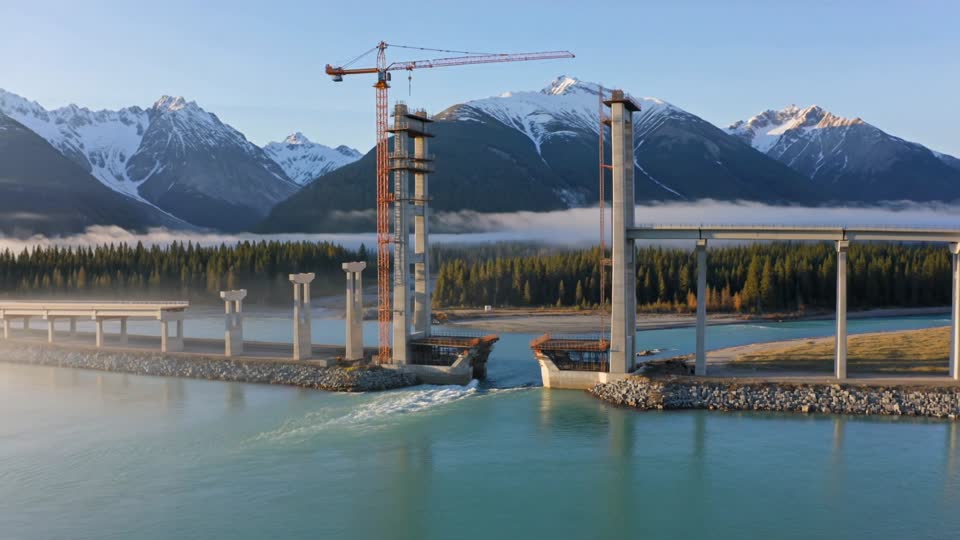
- Bridges. Substructure (foundations, abutments, piers) and superstructure (girders or beams, deck, barriers) carrying a road, rail line or path over a gap.
- Culverts. Pipe or box structures carrying water under a road, sized from a small drainage pipe up to a structural plate arch large enough to walk through.
- Other structures. Retaining walls, sign and signal structures, and marine structures such as wharves, which are covered on their own pages: see grading, lot grading and retaining walls and marine construction.
Deep foundation work, high-performance concrete and inspection-driven rehabilitation set structures apart from the earthworks and paving that connect to them on either end.
STA 0+240How a bridge gets built
- Foundations. Piles or spread footings are installed first, sized from a geotechnical investigation of the crossing.
- Substructure. Abutments and piers are formed and poured on top of the foundations.
- Superstructure erection. Steel or precast concrete girders are set by crane, or falsework is built to support a cast-in-place structure.
- Deck. Reinforcing steel is placed and the deck is poured, usually in a sequence of pours to control shrinkage cracking.
- Waterproofing and surfacing. A membrane protects the deck concrete before an asphalt or concrete wearing surface goes on.
- Barriers, approach work and commissioning. Barriers and expansion joints are installed, approach roadway is tied in, and the structure is load-tested or inspected before opening.
Work over water or a live roadway adds its own constraints: in-water timing windows to protect fish habitat, and traffic staging to keep a crossing open, or a detour, while the old structure comes out.
STA 0+360Deep foundations: piles
Most bridges sit on driven or drilled piles rather than a shallow footing, because the load has to reach competent soil or bedrock well below the streambed or roadway. Alberta's highway price averages for the main pile types:
| Item | Unit | 2026 avg | Contracts | 2025 | 2024 |
|---|---|---|---|---|---|
| Supply of Piling - Plain Steel H-PileItem F812 | m | $262.86 | 16 | $189.93 | $321.45 |
| Supply of Piling - Galvanized Steel H-PileItem F813 | m | $398.18 | 5 | — | — |
| Supply of Piling - Plain Steel Pipe PileItem F814 | m | $452.68 | 3 | — | — |
| Supply of Piling - Galvanized Steel Pipe PileItem F815 | m | $697.17 | 3 | — | — |
| Pile DrivingItem F818 | m | $61.14 | 18 | $45.08 | $56.97 |
| Concrete - PileItem F822 | m³ | $1,237 | 9 | $749.39 | $1,166 |
Driven steel H-piles and pipe piles are supplied by the metre and then driven; pile set-up (mobilizing the rig to a new pile location) and driving are priced separately from the material itself. Drilled and cast-in-place piles instead price a rig set-up and the concrete placed in the shaft. Dynamic load testing (a pile driving analyzer test) confirms a driven pile's capacity without a full static load test, and on Alberta contracts averages $2,669 per test1 per test; drill rig set-up for drilled piles averages $2,684 per pile1.
STA 0+480Concrete classes and reinforcing steel
Bridge concrete is specified to a higher class than a sidewalk or curb, because it has to resist freeze-thaw cycling, de-icing salt and decades of exposure. Alberta's two structural classes average:
| Item | Unit | 2026 avg | Contracts | 2025 | 2024 |
|---|---|---|---|---|---|
| Concrete - Class CItem F834 | m³ | $3,316 | 19 | $2,929 | $2,485 |
| Concrete - Class HPCItem F841 | m³ | $4,133 | 21 | $3,135 | $2,824 |
Class HPC (high-performance concrete) costs more than Class C because of its lower permeability and stricter mix design, and is typically specified for decks and other elements most exposed to chloride from de-icing salt. Reinforcing steel follows the same logic: plain black rebar is the base case, while corrosion-resistant and stainless reinforcing steel cost several times more per kilogram but are specified where salt exposure and a long service life make corrosion the dominant risk:
| Item | Unit | 2026 avg | Contracts | 2025 | 2024 |
|---|---|---|---|---|---|
| Plain Reinforcing Steel - SupplyItem F850 | kg | $2.94 | 19 | $2.90 | $4.27 |
| Corrosion Resistant Reinforcing Steel - SupplyItem F851 | kg | $11.04 | 18 | — | — |
| Stainless Reinforcing Steel - SupplyItem F853 | kg | $11.41 | 15 | — | — |
| Reinforcing Steel - PlaceItem F854 | kg | $2.54 | 28 | $2.41 | $2.94 |
STA 0+600Deck repair, overlay and waterproofing
A bridge deck is usually the first part of a structure to need work, because it takes direct traffic load and de-icing salt. Alberta's rehabilitation items separate partial depth repair (patching spalled or delaminated concrete that has not gone through the full slab) at $2,233 per m²1 from full depth repair (removing and replacing concrete through the full deck thickness) at $5,149 per m²1. A deck overlay adds a new wearing layer of concrete over the existing deck, priced separately for the concrete supply at $1,909 per m³1 and its placement at $129.75 per m²1, and waterproofing membrane below the wearing surface averages $84.68 per m²1. Rehabilitation work like this keeps an aging structure in service for years without the cost and disruption of full replacement.
STA 0+720Culverts and structural plate structures
A culvert is a buried structure, but it is engineered like a bridge: sized for a design flood, checked for structural capacity under the fill and traffic above it, and inspected on the same cycle as a bridge. Corrugated steel pipe (C.S.P.) and reinforced concrete pipe (R.C.P.) cover most diameters:
| Item | Unit | 2026 avg | Contracts | 2025 | 2024 |
|---|---|---|---|---|---|
| Culverts - Supply and Install (400 mm dia. C.S.P.)Item D400 | m | $436.43 | 1 | — | — |
| Culverts - Supply and Install (600 mm dia. C.S.P.)Item D410 | m | $372.25 | 20 | $377.36 | $406.02 |
| Culverts - Supply and InstallItem D420 | m | $990.33 | 1 | — | — |
| Culverts - Supply and Install (1 200 mm dia. C.S.P.)Item D435 | m | $1,081 | 5 | $1,070 | $993.31 |
| Culverts - Supply and Install (450 mm dia. R.C.P.)Item D460 | m | $515.04 | 2 | — | — |
| Culverts - Supply and Install (600 mm dia. R.C.P.)Item D465 | m | $637.85 | 2 | $1,827 | — |
| Culverts - Supply and Install (900 mm dia. R.C.P.)Item D475 | m | $1,158 | 1 | — | — |
Above a certain span, a round pipe is no longer practical and the culvert becomes a structural plate corrugated steel pipe (SPCSP): curved steel plates bolted together on site into an arch or pipe-arch shape, supplied and then assembled separately:
| Item | Unit | 2026 avg | Contracts | 2025 | 2024 |
|---|---|---|---|---|---|
| SPCSP - SupplyItem F493 | m | $2,865 | 7 | — | — |
| SPCSP - AssemblyItem F494 | m | $1,777 | 7 | — | — |
| CSP with Couplers - SupplyItem F495 | m | $1,220 | 7 | — | — |
| CSP - AssemblyItem F496 | m | $740.33 | 7 | — | — |
Large SPCSP structures are common where a highway crosses a wide, shallow watercourse and a full bridge is not needed. See culvert installation cost for smaller municipal and rural sizes.
STA 0+840The state of Canada’s bridges, culverts and tunnels
Provincial and territorial governments own 69% of Canada's bridges and tunnels by replacement value2, and the country counted 48,360 publicly owned bridges and 34,908 large culverts (3 m diameter or greater) at the end of 202233. Bridges and tunnels together carry a combined replacement value of about $294,895.8 million (roughly $295 billion)4. Of the bridge and tunnel inventory, 14.6% was rated poor or very poor condition5, close to the 11.5% rate for large culverts5 and 12.4% for smaller stormwater culverts under 3 m5. Statistics Canada's national accounts model separately puts the average age of Canada's bridges at 9.1 years with a remaining service life ratio just over 60%6. Tunnels are a much smaller inventory, 538 across the country3, with 7.3% rated poor or very poor condition5; most Canadian tunnel work is transit and utility construction in a handful of large cities rather than a distinct highway discipline. As with roads, a large and steady share of structures work is inspection-driven rehabilitation rather than new crossings, which is why the pay items above split so finely between new construction, patching and full-depth replacement: an owner needs to buy exactly the scope of repair the inspection called for, not a bigger job than the deterioration justifies.
STA 0+960What to send for a price
A structure is priced from engineering drawings, not a description, because span, loading, foundation type and concrete class all drive cost independently. A useful brief includes:
- Structural drawings, or at minimum the span, deck width and expected traffic loading.
- A geotechnical report covering the foundation soil or rock and the water table.
- Whether the work is new construction or rehabilitation of an existing structure, and its current inspection history.
- Access for cranes and piling equipment, and any in-water work window that applies.
- Traffic staging requirements if the structure carries a live road.
- The schedule, including any construction season limits at the site.
Ask how concrete class and reinforcing steel type were selected, what happens if the foundation conditions differ from the geotechnical report, and how deck rehabilitation quantities will be verified once the old surface is removed and the real extent of deterioration is visible. Those answers predict most disputes on a structures job.
Questions people ask
What is the difference between Class C and Class HPC concrete?
Class HPC (high-performance concrete) has a stricter mix design and lower permeability than Class C, giving it better resistance to chloride penetration from de-icing salt. It is typically specified for bridge decks and other elements with the highest exposure and the longest required service life, and costs more per cubic metre as a result.
How deep do bridge piles go?
Deep enough to reach competent soil or bedrock able to carry the structure’s load, which varies by site and is set by a geotechnical investigation rather than a standard depth. Pile length, driving resistance and, often, a dynamic or static load test confirm capacity during construction.
What is the difference between a culvert and a bridge?
There is no fixed size cutoff; a culvert is generally a buried, closed structure (pipe, box or arch) carrying water under a road, while a bridge is an open span. Above a certain size a culvert becomes structurally similar to a bridge and is inspected the same way, and a very large structural plate culvert can look, functionally, much like a small bridge.
Why do bridge decks need to be repaired so often?
Decks take direct traffic load and are the part of a structure most exposed to water and de-icing salt, which corrodes reinforcing steel and cracks the surrounding concrete. Partial and full depth repairs, overlays and waterproofing extend a deck’s service life without replacing the whole structure.
What is SPCSP?
Structural plate corrugated steel pipe: curved steel plates bolted together on site into a large arch, pipe-arch or box shape. It is used for culverts too large for a standard round pipe, and is supplied and assembled as two separate priced items.
Sources
- Unit Price Averages (workbook updated 2026-06-24)Alberta Transportation and Economic Corridors · 2026
- The Daily - Canada's Core Public Infrastructure Survey: Replacement values, 2022Statistics Canada · 2022
- Table 34-10-0287-01 Inventory of core public infrastructure assetsStatistics Canada · 2022 ref year; released 2025-02-04
- Table 34-10-0284-01 Estimated replacement value, required renewal budget and actual renewal expenditures of core public infrastructure assets, by physical condition ratingStatistics Canada · 2022 ref year; released 2025-06-24
- Table 34-10-0288-01 Inventory distribution of core public infrastructure assets by physical condition ratingStatistics Canada · 2022 ref year; released 2025-02-04
- Table 36-10-0611-01 Infrastructure Economic Accounts, average age and remaining useful service life ratio by asset and asset functionStatistics Canada · 2025; released 2026-06-12
Related
-
 C-101
Earthworks & excavation
Stripping, bulk excavation, cut and fill, rock, compaction and the volumes that drive every estimate.
C-101
Earthworks & excavation
Stripping, bulk excavation, cut and fill, rock, compaction and the volumes that drive every estimate.
-
 C-102
Site servicing & land development
Water, sewer, storm and roads for new lots, and the agreements, levies and sequence that come with them.
C-102
Site servicing & land development
Water, sewer, storm and roads for new lots, and the agreements, levies and sequence that come with them.
-
 C-103
Underground utilities
Watermain, sanitary and storm sewer, manholes and services, from trench design to testing.
C-103
Underground utilities
Watermain, sanitary and storm sewer, manholes and services, from trench design to testing.