Discipline · Sheet C-110
Marine construction
Building at the water's edge means the same piling, concrete and rock work as the rest of civil construction, done from a barge instead of solid ground, on a schedule set by fish, ice and navigation as much as by the contractor.
Marine construction is civil work that happens to be next to, or in, water: wharves and docks, seawalls and breakwaters, boat launches, and the piling that carries a pier or a marine terminal. The trades are familiar — piling, concrete, rock placement — but almost everything about how the work is mobilized, sequenced and approved changes once a barge replaces a truck.
STA 0+120What marine construction covers
Marine and shoreline work spans a range of structures, most of which are variations on piling, concrete and rock:
- Wharves and docks. Pile-supported decks for berthing vessels, loading cargo, or public access to the water.
- Seawalls and bulkheads. Vertical retaining structures that hold back the shoreline, often steel sheet pile or concrete.
- Breakwaters and groynes. Rock or concrete structures built to reduce wave energy or manage sediment movement along a shoreline.
- Riprap and armour. Placed rock protecting a bank, causeway or structure from erosion and wave action.
- Dredging. Removing sediment to create or maintain a channel or berth depth, usually a specialized subcontract of its own.
Marine piers and abutments for bridges over water share equipment and technique with this discipline but are usually scoped under bridges, culverts and structures. Outfalls and intakes that cross the shoreline connect to underground utilities on the land side.
What makes marine work its own discipline is not the materials but the site: every piece of equipment, every worker and every load of rock or concrete has to get to a work face that has no road. On Canada's coasts that means working around tide, swell and, on the west coast and the Atlantic, a short in-water construction season set by fisheries timing windows. On lakes and rivers it means working around spring freshet, ice-out and ice-up, and on the Great Lakes and St. Lawrence Seaway around active shipping traffic.
STA 0+240Piling from a barge
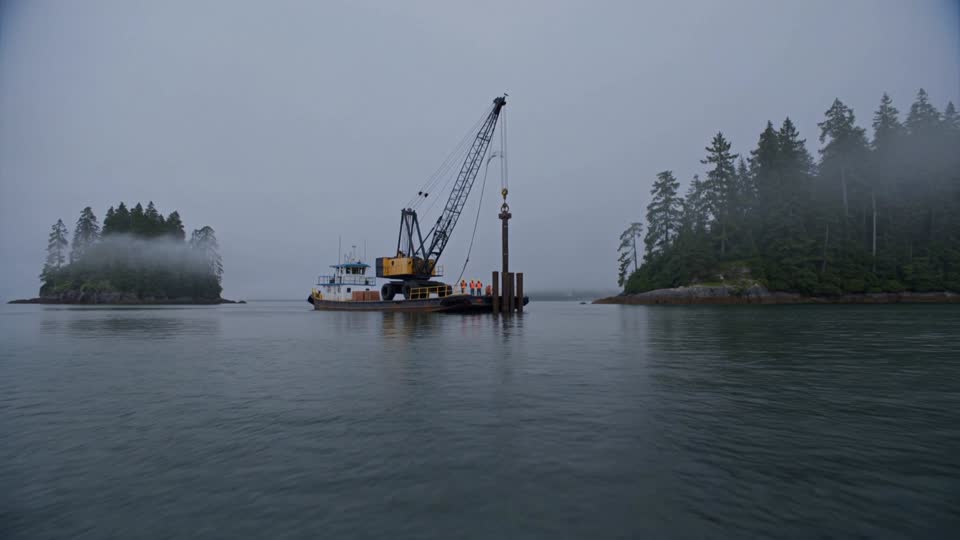
A marine piling rig is usually a crane and hammer or vibratory driver mounted on a barge, floated and anchored or spudded into position over the pile location. The piles themselves are the same products used on land: steel H-piles, steel pipe pile (often filled with concrete once driven), and occasionally timber for lighter structures. Alberta Transportation and Economic Corridors publishes provincial averages for these items on highway bridge work, which are a useful land-based benchmark for material and driving cost even though they are not marine prices:
| Item | Unit | 2026 avg | Contracts | 2025 | 2024 |
|---|---|---|---|---|---|
| Supply of Piling - Plain Steel H-PileItem F812 | m | $262.86 | 16 | $189.93 | $321.45 |
| Supply of Piling - Galvanized Steel H-PileItem F813 | m | $398.18 | 5 | — | — |
| Supply of Piling - Plain Steel Pipe PileItem F814 | m | $452.68 | 3 | — | — |
| Supply of Piling - Galvanized Steel Pipe PileItem F815 | m | $697.17 | 3 | — | — |
| Pile Set-up (Driven Piles)Item F816 | pile | $4,652 | 18 | — | — |
| Pile DrivingItem F818 | m | $61.14 | 18 | $45.08 | $56.97 |
Plain steel H-pile supply averaged $262.86 per m1 and pile driving averaged $61.14 per m1, with a per-pile set-up charge of $4,652 per pile1 on top of the driven length. On a marine job the pile supply and driving rates are only part of the story: a barge, tug, spuds or anchoring system, and often a diver for underwater inspection or cutoff, add mobilization and standby cost that does not show up in a land-based highway average at all. Treat these figures as a benchmark for material and driving productivity, not as a marine quote.
STA 0+360Riprap and shoreline armour
Placed rock is the default protection against wave and current erosion, sized in classes from bedding stone up to heavy armour rock. Alberta's highway program tenders riprap and rock armour as its own family of pay items, again a useful land-based benchmark for supply and placement:
| Item | Unit | 2026 avg | Contracts | 2025 | 2024 |
|---|---|---|---|---|---|
| Coarse Rip-rap Bedding Zone 5BItem C102 | m³ | $96.73 | 1 | — | — |
| Gravel Armour Zone 5CItem C105 | m³ | $129.52 | 2 | — | — |
| Riprap Zone 6BItem C120 | m³ | $167.64 | 1 | — | — |
| Heavy Rock Riprap (Class 1)Item F500 | m³ | $292.55 | 38 | $315.15 | $342.75 |
| Heavy Rock Riprap (Class 1M)Item F505 | m³ | $288.57 | 11 | — | — |
| Heavy Rock Riprap (Class 2)Item F515 | m³ | $266.80 | 9 | — | — |
| Heavy Rock Riprap (Class 3)Item F525 | m³ | $426.33 | 1 | — | — |
| Random Riprap - Supply and PlaceItem D555 | m³ | $587.78 | 3 | — | — |
Heavy rock riprap Class 1 averaged $292.55 per m³1 and the lighter Class 2 averaged $266.80 per m³1, while random riprap supplied and placed as a single item averaged $587.78 per m³1. The right class and layer thickness for a shoreline or causeway depends on wave height, current velocity and the design life of the structure, which is an engineering design question rather than a pricing one; a geotechnical or coastal engineer typically specifies the rock class and gradation before a contractor prices the placement.
STA 0+480In-water work: fisheries and navigation approvals
Work that touches a Canadian waterway is layered with federal approvals on top of the usual provincial and municipal ones. Two are worth knowing before scoping a marine job:
- Fisheries Act authorization. Fisheries and Oceans Canada's Projects Near Water process reviews whether a project is likely to cause the death of fish or the harmful alteration, disruption or destruction of fish habitat, and whether an authorization is required2.
- Navigable waters approval. Transport Canada's Navigation Protection Program reviews works built in, on, over, under, through or across a navigable water, with minor works that meet published criteria exempt and major works requiring an approval before construction3.
Both reviews can carry conditions on timing, such as restricted in-water work periods meant to protect fish spawning or migration. Those windows are set project-by-project and waterbody-by-waterbody by the regulator, not by a fixed national calendar, so this page does not quote a specific date range: confirm the applicable window directly with DFO or the responsible provincial fisheries authority for the waterbody in question.
Not legal advice
Federal approvals for work near or in water are assessed project by project. Confirm whether your project needs a Fisheries Act authorization or a navigable waters approval, and what conditions apply, before scheduling in-water work.
STA 0+600Dredging and disposal
Dredging removes sediment to create or maintain a channel, berth or intake depth, using mechanical equipment (clamshell or backhoe dredges) or hydraulic equipment (cutter suction or trailing suction hopper dredges) depending on the material and the volume. It is its own specialized trade with its own equipment fleet, and disposal of dredged material is a project in itself: options range from open-water disposal at an approved site to upland placement or beneficial reuse, each with its own approvals. There is no published Canadian benchmark price for dredging comparable to the Alberta highway averages used elsewhere on this page, so a dredging scope needs its own quote rather than a rule of thumb.
Sediment quality matters as much as sediment volume: material dredged near an industrial waterfront or a historical discharge point may need to be tested before a disposal option is chosen, and contaminated sediment can require confined disposal rather than open water placement. That testing and classification usually happens well ahead of construction, as part of the environmental review that supports the Fisheries Act and navigable waters approvals described above.
STA 0+720Tendering marine work
Federal marine construction is filed on CanadaBuys under UNSPSC code 721412004 for marine construction services, with dredging services broken out separately under code 721412064. Port authorities, harbour commissions and provincial transportation ministries also tender marine work directly through their own portals or through provincial tender portals; see the live tender feed and the bid, performance and payment bonds guide, since marine contracts commonly require bonding given the specialized equipment involved.
STA 0+840What to send for a price
A marine scope that gets a firm number usually includes:
- Drawings or a sketch of the structure, with water depth, tidal or seasonal water-level range, and bottom conditions if known.
- Access: whether a barge can be launched nearby, and whether a crane pad or laydown area exists on shore.
- Whether a Fisheries Act authorization or navigable waters approval has been applied for, and any in-water work window already confirmed by the regulator.
- The pile type and estimated length, or the rock class and quantity, if a design already exists.
- The schedule, including any ice-out or freeze-up constraint on the waterbody.
Ask how the contractor prices barge mobilization and standby, since weather and water-level delays are the most common source of extra cost on a marine job, more so than on land-based civil work.
Questions people ask
Do I need federal approval to build a dock or wharf in Canada?
Is there a set season for in-water construction work?
Restricted in-water work timing windows are set by the regulator for the specific waterbody and species present, not by a fixed national calendar. Ask Fisheries and Oceans Canada or the relevant provincial fisheries authority for the window that applies to your project before scheduling.
How is marine piling priced compared to land-based piling?
The pile material and driving rates are similar in principle; Alberta highway bridge piling averaged $61.14 per m1 for driving in 2025–26 as a land-based benchmark. Marine work adds barge, tug, anchoring and diving costs that a land-based average does not capture, so a marine quote is usually higher per metre.
What rock class is used for riprap and shoreline armour?
Rock class and layer thickness are set by a geotechnical or coastal engineer based on wave height, current and design life, not chosen by the contractor. Alberta highway contracts priced heavy rock riprap Class 1 at $292.55 per m³1 in 2025–26 as a supply-and-place benchmark.
Who dredges a channel or berth in Canada?
Dredging is a specialized trade with its own equipment (mechanical or hydraulic dredges) and its own disposal approvals for the sediment removed. There is no standard published unit price for dredging comparable to highway earthworks, so it is quoted project by project.
Sources
- Unit Price Averages (workbook updated 2026-06-24)Alberta Transportation and Economic Corridors · 2026
- Projects near waterFisheries and Oceans Canada · 2026-09-24
- Works on navigable waters in CanadaTransport Canada · 2026-09-24
- Mapping of GSIN-UNSPSC (CSV)Public Services and Procurement Canada · file dated 2021-05-12
- Table 34-10-0063-01 Capital expenditures, non-residential tangible assets, by type of asset and geographyStatistics Canada · 2024
Related
-
 C-101
Earthworks & excavation
Stripping, bulk excavation, cut and fill, rock, compaction and the volumes that drive every estimate.
C-101
Earthworks & excavation
Stripping, bulk excavation, cut and fill, rock, compaction and the volumes that drive every estimate.
-
 C-102
Site servicing & land development
Water, sewer, storm and roads for new lots, and the agreements, levies and sequence that come with them.
C-102
Site servicing & land development
Water, sewer, storm and roads for new lots, and the agreements, levies and sequence that come with them.
-
 C-103
Underground utilities
Watermain, sanitary and storm sewer, manholes and services, from trench design to testing.
C-103
Underground utilities
Watermain, sanitary and storm sewer, manholes and services, from trench design to testing.