Guide · Sheet G-402
How deep can you dig without shoring?
A trench does not warn you before it collapses. Every province sets a depth beyond which a worker cannot enter an unprotected trench, and the exact number is not the same from coast to coast.
Cave-ins kill with almost no warning. A cubic metre of ordinary soil weighs well over a tonne, and a trench wall can let go in seconds. Every Canadian occupational health and safety regulator responds the same way: past a certain depth, a worker cannot be in an unprotected trench, full stop. What differs by province is the exact trigger depth, when a professional engineer has to sign off, how far back the spoil pile has to sit, and how the soil itself gets classified. This guide lines up what the current regulations say, province by province, with the section numbers so you can check the original text.
STA 0+120Four ways to protect a trench
Every province's rules boil down to the same four tools, used alone or combined:
- Sloping. Cutting the trench walls back at an angle so they cannot collapse on a worker. The allowable angle depends on the soil type.
- Benching. Cutting the walls back in a series of steps rather than one continuous slope.
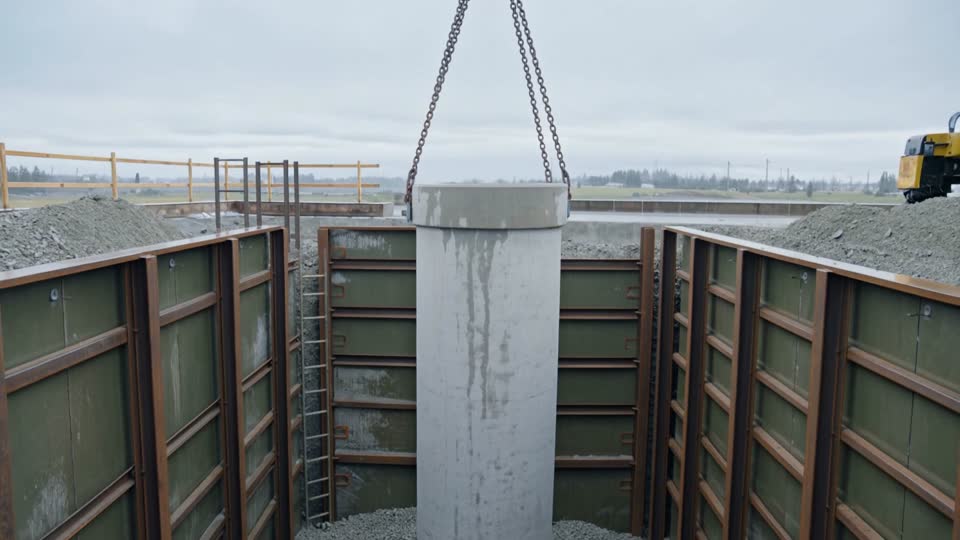
- Shoring. Timber, hydraulic or mechanical bracing installed against the trench walls to hold them in place. Alberta's Schedule 9 lumber-shoring tables, for example, cover trenches up to 6 m deep1.
- A trench box (shield). A prefabricated steel or aluminum structure a worker stays inside of; it does not stop a collapse but protects the worker if one happens.
None of these are interchangeable by choice once a job is deep enough to need an engineer: past the thresholds below, the support has to be designed for that specific excavation, not picked off a generic chart.
STA 0+240Protection triggers by province
The table below pulls the trigger depth, the engineer-design threshold, the spoil or equipment setback and the ladder or safe-exit distance from each province's current excavation regulation. Where a fact was not confirmed in the current text of the regulation, the cell says so rather than guessing.
| Province | Protect a worker deeper than | Engineer-designed support required | Spoil / equipment setback | Ladder or safe exit within |
|---|---|---|---|---|
| British Columbia | 1.2 m2 | 6 m, or sooner near a structure or steep ground (written instructions of a qualified registered professional)2 | Not specified in the regulation text reviewed | 8 m2 |
| Alberta | 1.5 m1 | 3 m (professional engineer's specifications)1 | 1 m from the edge, spoil sloped no more than 45°1 | 8 m1 |
| Saskatchewan | 1.2 m3 | 3 m (open excavation); 6 m in Type 1–3 soil or 4 m in Type 4 soil (trench)3 | 1 m; hand-dig within 600 mm of a known line3 | 8 m3 |
| Manitoba | 1.5 m (trench); 1.5 m (open excavation, sloping/shoring required)4 | 4.5 m (trench); 3 m (open excavation)44 | Not specified in the regulation text reviewed | Not specified in the regulation text reviewed |
| Ontario | 1.2 m5 | Deeper than 6 m, or wider than 3.6 m (site-specific engineered system); every prefabricated or hydraulic system must be engineer-designed regardless of depth55 | 1 m level area kept clear5 | Not specified in the regulation text reviewed |
| Quebec | No blanket trigger: banks must be shored to an engineer's plans for any trench a worker enters, unless sloped to within 1.2 m of the bottom, cut in rock, or an engineer certifies it is unnecessary6 | Default is engineer's plans and specifications, with the same 1.2 m sloping exception6 | 1.2 m (materials); 3 m (vehicles and machines); shoring must extend 300 mm above grade6 | Every 15 linear metres6 |
| New Brunswick | 1.2 m7 | Any shoring, bracing or caging must be certified adequate by an engineer7 | 1.2 m; hand digging or an approved procedure within 600 mm of a line7 | Not specified in the regulation text reviewed |
| Nova Scotia | 1.2 m8 | Any trench cage must be engineer-certified; steeper slopes need an engineer's written certification8 | Not specified in the regulation text reviewed | 15 m8 |
| Prince Edward Island | 1.219 m (4 ft)9 | Shoring and bracing must be certified adequate by a professional engineer9 | 0.609 m (2 ft)9 | Not specified in the regulation text reviewed |
| Newfoundland and Labrador | 1.22 m10 | Not specified in the regulation text reviewed | 1.22 m from a trench edge; 1.52 m from a pit edge10 | Not specified in the regulation text reviewed |
Not safety advice
This table summarizes public regulation text for planning purposes. It is not a substitute for reading the current regulation, your employer's excavation procedure, or the judgment of the competent person assigned to the site. Yukon, the Northwest Territories and Nunavut were not researched for this table; confirm current requirements with the territorial regulator before working there.
STA 0+360The number changes with the soil
Every threshold above assumes a worst case unless the soil is classified. Ontario and Saskatchewan both use a four-type system (Type 1 through Type 4, hardest to softest), and a mixed soil profile is classified as the highest-numbered (softest) type present5. The allowable slope tightens as the soil gets softer:
- Ontario: Type 1–3 soil can be sloped to within 1.2 m of the bottom at 1V:1H; Type 4 soil must be sloped from the bottom at 1V:3H5.
- Saskatchewan: Type 1–2 soil to within 1.2 m of the bottom at 1H:1V (45°); Type 4 soil from the bottom at 3H:1V (about 19°)3.
- Alberta uses a similar idea without the numbered types: hard, compact soil can be cut back to within 1.5 m of the bottom at not less than 30° from vertical; soil likely to crack, or soft and sandy soil, needs at least 45° from vertical1.
None of this is something to eyeball. A soil that looks stable in dry weather can behave completely differently after rain, after a freeze-thaw cycle, or once vibration from a compactor or passing trucks starts working on the wall. Classifying soil correctly, and re-checking it if conditions change, is part of the job, not a one-time judgment call at the start of the day.
STA 0+480Extra rules near pipelines and buried utilities
The depth trigger is not the only number that matters. Several provinces add a proximity rule around buried lines, tighter than the general excavation setback:
- Alberta: mechanical excavation is not permitted within 600 mm of a buried pipeline unless the pipeline owner's representative is directly supervising, and any pipeline within 30 m of the work site must be located and marked before ground is disturbed11.
- Saskatchewan and New Brunswick both require hand digging or an approved exposure method within 600 mm of a known line37.
- Federally regulated pipelines: the prescribed no-dig-without-notice zone is 30 m on each side of the pipeline centreline, and a locate request has to go in at least three working days ahead1111.
This is why the sequence on every civil site puts locates before excavation, not after. See call before you dig for the one-call centre in each province, notice periods and what the paint colours mean.
STA 0+600When the job needs a professional engineer
Every province has a point where a generic shoring chart is not enough and a professional engineer has to design the support for that specific excavation. The trigger is usually depth (3 m in Alberta and Manitoba's open excavations, 6 m in Ontario, British Columbia and most Manitoba and Saskatchewan trenches), but Ontario is stricter for equipment: any prefabricated trench box or hydraulic shoring system needs an engineer's design regardless of how deep the trench is5. Quebec and the Atlantic provinces default the other way — an engineer's plans are the baseline requirement for any trench a worker enters, and sloping to within 1.2 m of the bottom without one is the exception, not the rule6.
Alberta carves out one more exception under section 449: sections 450 to 459 of the OHS Code do not apply at all if a professional engineer certifies that the ground formation is, and will remain, stable1. That certification has to hold for the life of the excavation, not just the day it was issued.
Compare this against the underground utilities work covered in underground utilities and the volumes and slope math in the trench excavation calculator and the slope and grade converter.
STA 0+720Read the full rules for your province
The numbers above are the excavation-specific rules. Each province also layers on locate requirements, road-use rules and, for public work, prompt-payment timelines that affect how a trenching job gets scheduled and paid. Start with Alberta, Ontario or British Columbia for the fuller provincial picture, or the excavation cost guide for what a trenching job tends to cost once shoring, dewatering and traffic control are added in.
Questions people ask
How deep can you dig a trench without shoring?
In Alberta, a worker cannot be in a trench deeper than 1.5 m without protection1. In Ontario, British Columbia, Saskatchewan, New Brunswick and Nova Scotia the trigger is 1.2 m5. Prince Edward Island uses 1.219 m (4 ft)9 and Newfoundland and Labrador 1.22 m10. Quebec does not set a single depth; shoring to an engineer's plans is the default for any trench a worker enters, unless it is sloped within 1.2 m of the bottom or cut in rock6.
What is the difference between sloping, benching, shoring and a trench box?
Sloping cuts the walls back at an angle; benching cuts them back in steps. Shoring braces the walls in place with timber, hydraulic or mechanical supports. A trench box does not stop a collapse — it protects a worker inside it if one happens. Provinces regulate which methods are acceptable at which depth and soil type.
Do I need a professional engineer to design a trench box or shoring?
Past a threshold depth in most provinces (3 m in Alberta and for Manitoba open excavations, 6 m in Ontario, BC and most Manitoba and Saskatchewan trenches), yes. Ontario is stricter still: any prefabricated trench box or hydraulic shoring system needs an engineer's design at any depth5. Quebec defaults to engineer-designed shoring for any trench a worker enters, unless it is sloped within 1.2 m of the bottom6.
Is solid rock exempt from shoring rules?
How close can I dig to a gas line or other buried utility?
Several provinces require hand digging or an approved exposure method within 600 mm of a known buried line3, and Alberta requires the pipeline owner's representative to directly supervise any mechanical excavation within 600 mm of a pipeline1. Get locates before digging: see call before you dig.
Sources
- Alberta OHS Code (Alta Reg 191/2021), Part 32 Excavating and TunnellingGovernment of Alberta (OHS legislation search) · retrieved 2026-09-24
- WorkSafeBC OHS Regulation Part 20, Construction, Excavation and Demolition (ss. 20.78-20.95)WorkSafeBC · retrieved 2026-09-24
- The Occupational Health and Safety Regulations, 2020 (RRS c S-15.1 Reg 10), Part 17 Excavations, Trenches, Tunnels and Excavated ShaftsGovernment of Saskatchewan (Publications Saskatchewan) · consolidation incl. SR 31/2021 (unofficial consolidation)
- Workplace Safety and Health Regulation, M.R. 217/2006, Part 26 Excavations and TunnelsGovernment of Manitoba (Manitoba Laws) · current 2026-09-01 to 2026-09-22
- O. Reg. 213/91 Construction Projects, Part III Excavations (ss. 222-242)Government of Ontario (e-Laws) · consolidation current to 2026-09-21
- Safety Code for the construction industry, CQLR c S-2.1, r. 4, subdivision 3.15 (Excavation and trenching work)Publications Quebec (LegisQuebec) · retrieved 2026-09-24
- New Brunswick Regulation 91-191 (General Regulation - OHS Act), Part XIII Excavations and Trenches, ss. 180-188 (WorkSafeNB excerpt)WorkSafeNB · excerpt incl. amendments to 2001-33; verify currency at laws.gnb.ca
- Occupational Safety General Regulations (N.S.), Part 14 Excavations and Trenches (ss. 166-173)Government of Nova Scotia · retrieved 2026-09-24
- Occupational Health and Safety Act General Regulations (PEI), Part 12 Excavations, Trenches and ConstructionGovernment of PEI (Legislative Counsel Office) · office consolidation current to 2025-01-01
- Occupational Health and Safety Regulations, 2012 (NLR 5/12), Part XVIII Excavation, Underground Work and Rock Crushing (ss. 404-413)House of Assembly of Newfoundland and Labrador · retrieved 2026-09-24
- Canadian Energy Regulator Pipeline Damage Prevention Regulations - Authorizations (SOR/2016-124)Justice Laws Website (Government of Canada) · retrieved 2026-09-24
Related
-
 G-401
Call before you dig
One-call centres by province, notice periods, what the paint means and what to do when marks are missing.
G-401
Call before you dig
One-call centres by province, notice periods, what the paint means and what to do when marks are missing.
-
 G-403
Spring road bans
Why thaw closes roads to heavy loads, how Alberta, Saskatchewan, Manitoba and Ontario set them, and how to plan around them.
G-403
Spring road bans
Why thaw closes roads to heavy loads, how Alberta, Saskatchewan, Manitoba and Ontario set them, and how to plan around them.
-
 G-404
Construction holdbacks
The statutory holdback in each province, when it is released, and what it means for cash flow.
G-404
Construction holdbacks
The statutory holdback in each province, when it is released, and what it means for cash flow.