Discipline · Sheet C-112
Aggregates and gravel
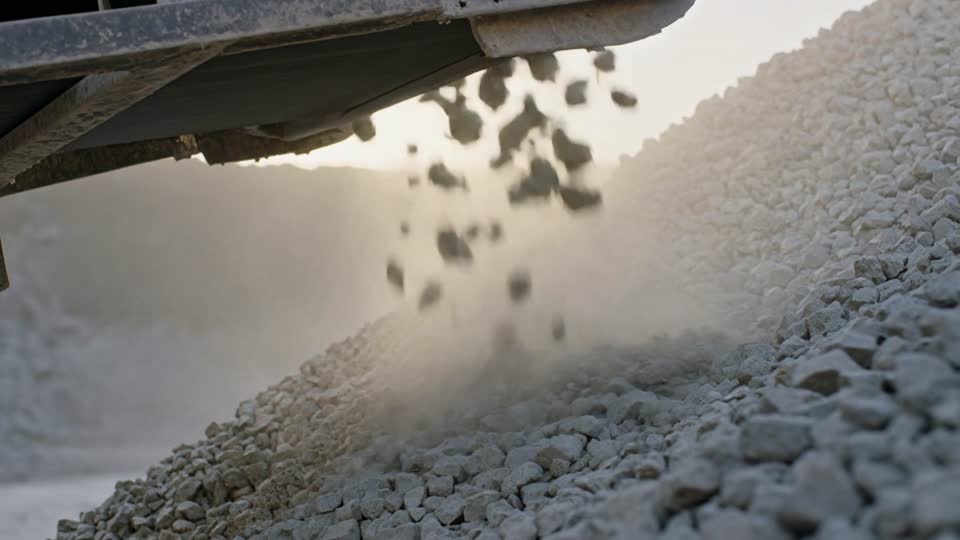
Almost every civil structure sits on, or is built from, crushed rock: pit run under a lot, base course under a road, ballast under track, riprap on a bank. This is how aggregate is graded, priced and hauled in Canada.
Aggregate is the highest-volume material on almost every civil job: the pit run under a subdivision, the granular base under a road, the crushed rock under a rail line, the riprap on a riverbank. It looks like a commodity, but it is sold and specified against a gradation, a source and a haul distance, and all three move the price more than the label on the pay item does.
STA 0+120What "aggregate" means on a job
Civil specifications use a handful of recurring aggregate categories, each doing a different job in the structure:
- Pit run. Unprocessed or minimally processed gravel straight from the pit, used as bulk fill or a base layer where a tight gradation is not required.
- Crushed gravel or crushed granular. Screened and crushed to a specified gradation, used where strength and drainage matter, such as under pavement.
- Granular base and sub-base. Engineered layers under a road or pad, placed and compacted to specific density and often a specific gradation "class" set by the owner's specification.
- Surfacing gravel. The wearing course on an unpaved road, chosen for a balance of binding fines and drainage.
- Riprap and armour rock. Larger, sorted rock sizes used for erosion protection rather than structural support; see marine construction.
The same tonne of crushed rock can be priced completely differently depending on which of these categories it is sold under, because the specification, the testing and the handling differ even when the source pit is the same. See earthworks and excavation for how bulk cut and fill volumes relate to the granular layers described here, and roadbuilding and paving for how base and sub-base fit into a finished road section.
STA 0+240Gradations and specification classes
A gradation describes what proportion of a sample passes through a stack of sieves of decreasing size, from coarse rock down to fine sand and silt. Owners specify a gradation band, not a single number, because a well-graded mix of particle sizes compacts to a denser, stronger, better-draining layer than a single-size material does. Alberta's highway pay items name their specification class directly in the item description, for example "granular base course, design 2, class 25," where the numbers refer to the agency's own gradation and design tables rather than a generic industry standard. Municipal specifications (see municipal infrastructure) set their own gradation classes the same way, and a class from one owner's specification is not automatically interchangeable with another's, even when the material looks similar in a stockpile.
STA 0+360Bulk density: tonnes, cubic metres and trucks
Aggregate is sold by the tonne but placed and measured by the cubic metre, so converting between the two depends on the material's bulk density, and that density changes with moisture and how loosely or densely the material is sitting. As typical planning values, not measurements of a specific pit or stockpile:
| Material | Loose kg/m³ | Bank (in-place) kg/m³ |
|---|---|---|
| Gravel | 1,602–1,780 | 1,768–2,047 |
| Sand | 1,543–1,721 | 1,697–1,982 |
These typical values come from a U.S. Army earthmoving field manual11, converted from imperial units, and they should be treated as a planning starting point rather than a test result. A supplier's delivery ticket in tonnes and a specification written in cubic metres of compacted layer are two different units for the same material, and the density used to convert between them belongs in the estimate, not assumed after the fact. The gravel and aggregate tonnage calculator and the swell and shrink converter handle the conversion.
STA 0+480What aggregate costs: 2026 Alberta supply prices
Alberta Transportation and Economic Corridors publishes the average of the three lowest bids on every aggregate-related item it tenders. For contracts tendered between May 2025 and June 2026, the provincial averages were:
| Item | Unit | 2026 avg | Contracts | 2025 | 2024 |
|---|---|---|---|---|---|
| Crush, Haul and Stockpile GravelItem A501 | m³ | $42.58 | 1 | — | — |
| Supply of Aggregate - With OptionItem A800 | t | $3.27 | 16 | — | — |
| Supply of Aggregate - No OptionItem A805 | t | $1.29 | 14 | — | — |
| Granular FillItem B152 | t | $40.83 | 9 | — | — |
| Granular FillItem B153 | t | $53.83 | 6 | — | — |
| Granular Base CourseItem B281 | t | $26.75 | 1 | — | — |
| Granular Base Course - Des. 2 Cl. 25Item B282 | t | $33.65 | 26 | $29.03 | $32.51 |
| Granular Base CourseItem B283 | t | $56.33 | 1 | — | — |
| Gravel Surfacing - Des. 4 Cl. 20Item Q185 | t | $54.90 | 4 | — | — |
| Gravel Surfacing - Des. 4 Cl. 25Item Q186 | t | $39.03 | 13 | — | — |
| Granular Fill for MediansItem X415 | t | $38.32 | 1 | — | — |
| Pitrun Gravel Zone 4CItem C090 | m³ | $112.46 | 1 | — | — |
| Granular Backfill - CulvertsItem D200 | m³ | $90.94 | 4 | — | — |
| Granular Backfill - CulvertsItem D235 | t | $54.85 | 3 | — | — |
| Backfill - GranularItem F200 | m³ | $90.00 | 1 | — | — |
| Backfill - Crushed GranularItem F203 | m³ | $86.86 | 3 | — | — |
Aggregate supply with a gradation option averaged $3.27 per t2 per tonne, well above the $1.29 per t2 average for supply with no option, which reflects the extra crushing and screening needed to hit a specified gradation. Granular base course (design 2, class 25) averaged $33.65 per t2 per tonne, and pitrun gravel priced by the cubic metre in one region averaged $112.46 per m³2. These are highway-scale averages on large tendered quantities; a small residential or acreage job pays more per tonne because minimum loads, short-haul mobilization and a smaller negotiating position all push the price up. Use the gravel cost per tonne guide for smaller-job pricing and the unit price index for every item.
STA 0+600Haul economics and axle weights
For most aggregate jobs, hauling the material costs more than buying it, because a tonne of gravel is cheap relative to the diesel, driver time and truck wear needed to move it any real distance. Granular base course prices make the point on their own: the same item varies sharply by region on Alberta's highway program, which is mostly a haul-distance-to-pit signal rather than a difference in the material itself:
| Region | Avg per t | Contracts |
|---|---|---|
| Southern region | $28.37 | 4 |
| Central region | $35.07 | 13 |
| North Central region | $30.88 | 3 |
| Peace region | $41.56 | 6 |
| Province | $33.65 | 26 |
Alberta's Commercial Vehicle Dimension and Weight Regulation caps a tandem axle group with eight or more tires at 17,000 kg3, and a single steering axle at 7,300 kg3, before other limits such as tire load, bridge formula or a seasonal road ban apply. Those legal limits, not the truck's rated capacity, usually set how much payload a load can legally carry, which in turn sets how many truckloads a given tonnage works out to. The haul truck cycle time calculator turns a haul distance and cycle time into the number of trucks needed to keep a crusher or a placing crew supplied, and spring road bans covers the seasonal weight restrictions that can cut legal payloads well before the regulation's normal limits.
STA 0+720Sourcing and quality control
Aggregate comes from a pit (unconsolidated sand and gravel deposits) or a quarry (blasted and crushed bedrock), and the source affects both the material's properties and the approvals needed to extract it: pit and quarry operations are themselves regulated land uses, permitted separately from the civil work that consumes their output. Specifications typically call for testing, gradation checks, and sometimes source approval before a pit is accepted for a public contract, particularly where the aggregate will end up in concrete or asphalt rather than as fill. None of that testing regime is standard across every owner, so a contractor pricing supply from a new source should confirm what testing and approval the specification actually requires before assuming a pit is qualified. Recycled sources are increasingly part of the same market: crushed concrete and reclaimed asphalt pavement can substitute for virgin gravel in many granular applications, subject to the same gradation and quality testing as a natural source; see demolition and site clearing for how that material is generated in the first place.
STA 0+840What to send for a price
An aggregate brief that gets a firm number usually includes:
- The material category and, if known, the specification class or gradation required.
- Quantity, in tonnes or cubic metres, and whether that is loose, compacted or bank volume.
- Delivery location and access, including any load or route restrictions.
- Whether supply only, supply and haul, or supply, haul and place is being priced.
- The schedule, including any season-specific haul restriction that might apply.
Ask whether the quoted price is per tonne delivered or per tonne at the pit, since freight is usually the larger share of the delivered cost once haul distance grows past a few kilometres.
Questions people ask
How much does gravel cost per tonne in Canada?
On Alberta provincial highway contracts, aggregate supply with a gradation option averaged $3.27 per t2 and supply with no option averaged $1.29 per t2 in 2025–26. Small jobs pay more per tonne because minimum loads and short-haul mobilization are spread over less material. See the gravel cost per tonne guide.
What is the difference between pit run and crushed gravel?
Pit run is unprocessed or minimally processed material straight from the pit; crushed gravel is screened and crushed to hit a specified gradation band. Crushed material generally costs more because of the extra processing, and it performs more predictably under pavement.
How do I convert tonnes of gravel to cubic metres?
Using a bulk density: loose gravel is typically around 1,602 to 1,780 kg per cubic metre1, though the exact figure depends on the material and its moisture content. Use the gravel and aggregate tonnage calculator rather than a single rule of thumb for a real order.
Why does the same aggregate item cost so much more in one region than another?
Mostly haul distance to an approved pit or quarry. Alberta's granular base course averages range roughly from the mid-$20s to over $40 per tonne depending on the region, for what is largely the same specification. See the regional table in the pricing section above.
Sources
- FM 5-434 Earthmoving Operations, Chapter 1, Tables 1-1 and 1-2U.S. Department of the Army (field manual; hosted copy on GlobalSecurity.org) · FM 5-434 (2000)
- Unit Price Averages (workbook updated 2026-06-24)Alberta Transportation and Economic Corridors · 2026
- Commercial Vehicle Dimension and Weight Regulation, Alta Reg 315/2002, s. 9 (current as of April 1, 2025)Alberta King's Printer · current as of 2025-04-01
Related
-
 C-101
Earthworks & excavation
Stripping, bulk excavation, cut and fill, rock, compaction and the volumes that drive every estimate.
C-101
Earthworks & excavation
Stripping, bulk excavation, cut and fill, rock, compaction and the volumes that drive every estimate.
-
 C-102
Site servicing & land development
Water, sewer, storm and roads for new lots, and the agreements, levies and sequence that come with them.
C-102
Site servicing & land development
Water, sewer, storm and roads for new lots, and the agreements, levies and sequence that come with them.
-
 C-103
Underground utilities
Watermain, sanitary and storm sewer, manholes and services, from trench design to testing.
C-103
Underground utilities
Watermain, sanitary and storm sewer, manholes and services, from trench design to testing.