Discipline · Sheet C-109
Demolition and site clearing
Demolition clears a site for what comes next. It starts with a survey of what is built into the walls, runs through a sequenced teardown, and ends with material sorted for disposal or recycling.
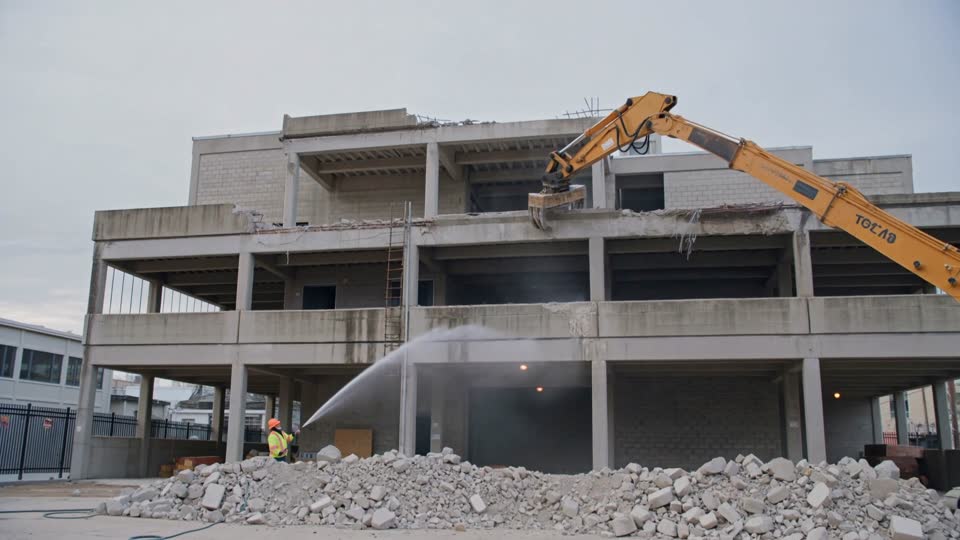
Demolition looks like the simple part of a project: knock it down, haul it away. In practice it is one of the more heavily sequenced trades in civil construction, because almost everything has to happen in the right order before a machine ever touches the structure. A hazardous materials survey comes first, then abatement, then utility disconnects, then the teardown itself, then sorting the debris for disposal or recycling. Skip a step and the job stops, or worse, someone gets hurt.
STA 0+120What demolition and site clearing covers
On a Canadian civil project, "demolition" and "site clearing" cover a range of distinct scopes that are often priced and permitted separately:
- Structure demolition. Full teardown of a building, tank, silo, bridge or other structure, down to grade.
- Selective demolition and soft-strip. Removing interior finishes, mechanical and electrical systems, or one part of a structure while the rest stays standing or is reused.
- Pavement and hardscape removal. Concrete and asphalt surfaces, curb and gutter, sidewalks, taken out ahead of reconstruction.
- Roadside hardware removal. Guardrail, fencing, signs and small drainage structures removed as part of a highway or utility project.
- Site clearing. Clearing and grubbing of vegetation is closer to earthworks than demolition; see earthworks and excavation for how that is scoped and priced.
Each of these is priced differently: structure demolition is usually a lump sum built up from the building's size, construction type and hazardous materials findings, while pavement and hardware removal on public contracts are unit-priced items measured by area, length or volume. The demolition cost guide covers the lump-sum side in more detail; this page focuses on scope, sequence and the unit-priced removal items.
STA 0+240Hazardous materials surveys before demolition
Before a structure of any age comes down, the standard first step is a hazardous materials survey (sometimes called a designated substances survey or a pre-demolition survey). A competent surveyor inspects and, where needed, samples the building for materials that are common in Canadian construction and that become dangerous when disturbed, including:
- Asbestos-containing materials. Pipe and boiler insulation, sprayed fireproofing, vermiculite insulation, floor tile and mastic, drywall joint compound, and some roofing and siding products, in buildings built or renovated before the 1990s in particular.
- Lead. Older paint, some solder and plumbing components, and certain coatings.
- Other designated substances. Depending on the building's history, this can include mercury (thermostats, switches), PCBs (older ballasts and transformers), mould, and ozone-depleting refrigerants.
What the survey finds drives the abatement plan: materials in poor condition or that will be disturbed by demolition are typically removed by a qualified abatement contractor before the structure is torn down, under the applicable provincial occupational health and safety rules for asbestos and other designated substances. Those rules, and the municipal demolition permit requirements that sit alongside them, differ by province and by municipality.
Not safety or legal advice
This page describes the general shape of a pre-demolition survey. The scope of testing, the abatement method and the permit process are set by your provincial occupational health and safety regulator and by your municipality's building and demolition permit requirements. Confirm both before any structure comes down, and do not rely on this page for a fee, timeline or specific procedure.
STA 0+360How a demolition job runs
- Hazardous materials survey. Before pricing or permitting, the building is surveyed for asbestos, lead and other designated substances.
- Abatement. Materials flagged by the survey are removed by a qualified abatement contractor, with air monitoring and disposal handled under provincial rules.
- Permits and disconnects. The municipality issues a demolition permit once utilities are confirmed disconnected or capped; buried services still need locates before ground is disturbed. See call before you dig.
- Salvage and soft-strip. Fixtures, equipment and reusable material are removed before the structural teardown starts.
- Structural demolition. Mechanical demolition with excavator-mounted shears, hammers or grapples handles most low-rise work; taller or heavier structures use high-reach excavators working from the ground up, floor by floor.
- Sorting and hauling. Concrete, asphalt, metal and wood are separated on site where practical, then hauled to a recycler, transfer station or landfill.
- Site restoration. The cleared site is graded and, if the next phase is not starting immediately, stabilized against erosion; see earthworks and excavation for grading and compaction.
On a highway or utility project the same logic applies at a smaller scale: locates and utility disconnects come first, then the removal item, whether that is a culvert, a length of guardrail or a section of curb and gutter.
STA 0+480What Alberta pays to remove pavement, culverts and roadside hardware
Alberta Transportation and Economic Corridors tenders removal work as its own set of pay items, separate from the new construction that follows. For contracts tendered between May 2025 and June 2026, the provincial averages were:
| Item | Unit | 2026 avg | Contracts | 2025 | 2024 |
|---|---|---|---|---|---|
| Asphalt Surfacing - Remove and DisposeItem X205 | m³ | $67.63 | 4 | $67.14 | $63.83 |
| Concrete Curb and Gutter - Remove and DisposeItem X215 | m | $32.60 | 1 | — | — |
| Concrete Surface - Remove and DisposeItem X220 | m² | $37.26 | 5 | $42.25 | $39.53 |
| Concrete Curb - Remove and DisposeItem X235 | m | $42.05 | 2 | — | — |
| Culverts - Remove and Dispose (C.S.P.) (up to 700 mm dia.)Item D100 | m | $119.48 | 21 | $95.40 | $110.43 |
| Culverts - Remove and Dispose (C.S.P.) (over 700 mm dia.)Item D105 | m | $149.60 | 16 | — | — |
| Culverts - Remove and DisposeItem D110 | m | $156.63 | 6 | — | — |
| Remove and Dispose of Existing GuardrailItem S825 | m | $25.19 | 19 | $17.90 | $24.58 |
| Remove and Dispose of Existing FenceItem G452 | km | $4,582 | 14 | — | — |
Concrete surface removal averaged $37.26 per m²1, and concrete curb and gutter removal averaged $32.60 per m1. Culvert removal is priced by length and rises with pipe size: corrugated steel culverts up to 700 mm diameter averaged $119.48 per m1, over 700 mm diameter averaged $149.60 per m1, and the general culvert removal item (other materials or unspecified pipe) averaged $156.63 per m1. Guardrail removal averaged $25.19 per m1, and fence removal is paid by the kilometre of fence line at $4,582 per km1, which only makes sense at rural highway scale.
These are highway-scale averages, weighted toward large contracts with dozens or hundreds of metres of a single item. A small urban job, such as removing one driveway apron or a short run of curb, pays more per unit because mobilization, traffic control, disposal tipping fees and contract minimums are spread over far less work. Use these figures as a benchmark for the unit rate on a larger removal package, and as a sanity check on a quote, not as a price for a single-lot job. The demolition cost guide and the unit price index cover the rest of the removal items.
STA 0+600Recycling concrete and asphalt
Concrete and asphalt pavement are among the most recyclable materials on a demolition site. Broken concrete is crushed and screened into recycled concrete aggregate, used as granular base, backfill or pipe bedding in place of virgin gravel; reclaimed asphalt pavement (millings) is either recycled back into new hot-mix at a plant or used as a granular surfacing material on lower-volume roads. Structural steel, rebar and other metals are separated for scrap value, and clean wood is chipped or reused where a local market exists.
What actually gets recycled on a given job depends on the volume, what the local market will take, and whether a crusher can mobilize to the site economically or the material has to be hauled to a fixed recycling yard. See aggregates and gravel for how crushed and recycled material is specified and priced alongside virgin pit run and crushed gravel.
STA 0+720Permits, locates and tendering demolition work
A municipal demolition permit is the norm for any structure demolition in Canada; requirements (application, notice to neighbours, utility disconnect confirmation, tree protection, dust and noise control) are set by the municipality and vary by city, so check with the local building department before applying a general rule from one city to another. Buried services on the property, and any private lines the owner has run to outbuildings, still need to be located before ground is disturbed, even on a site being cleared rather than dug; see call before you dig for notice periods by province.
Federal and provincial public-sector demolition work is tendered like any other civil contract. On CanadaBuys, demolition services are filed under UNSPSC code 721415102, with the older GSIN code 51122 for demolition work and 51132 for site formation and clearance still used in parallel by some departments. The CanadaBuys open-data files only carry federal notices, even though the portal lists tenders from other levels of government3, so most municipal demolition tenders are advertised on the municipality's own portal or on a shared platform; see bidding on public tenders and the live tender feed.
STA 0+840What to send for a price
A demolition brief that gets a firm number usually includes:
- The structure's size, age, construction type (wood frame, masonry, concrete, steel) and number of storeys, or the area and thickness of pavement to be removed.
- Whether a hazardous materials survey has been done, and what it found.
- Utility status: confirmed disconnected, or still live and needing disconnection.
- Access, adjacent structures, and any shoring or protection they need.
- What happens to the material: hauled off site, crushed and reused, or a mix.
- The schedule, including whether the site needs to be ready for a specific next phase.
Ask whether the price includes the hazardous materials survey and abatement or assumes they are handled separately, and who carries the disposal and tipping fee risk if the volume of debris turns out higher than expected. Those two questions account for most disputes on demolition jobs.
Questions people ask
Do I need an asbestos and lead survey before demolishing a building?
A hazardous materials survey is the standard first step before any structure demolition in Canada, and provincial occupational health and safety rules generally require the employer to know what designated substances are present before work begins. Confirm the exact requirement with your provincial OHS regulator and municipal building department, since the process is not identical everywhere.
How much does it cost to remove concrete or asphalt pavement?
On Alberta provincial highway contracts, concrete surface removal averaged $37.26 per m²1 and asphalt surfacing removal averaged $67.63 per m³1 in 2025–26. Small urban jobs cost more per unit because mobilization, traffic control and disposal fees are spread over far less material. See the demolition cost guide.
What happens to demolished concrete and asphalt?
Concrete is typically crushed into recycled aggregate for base, backfill or bedding, and asphalt millings are recycled into new hot-mix or used as surfacing on lower-volume roads, where a local market and a crusher are available. See aggregates and gravel.
Do I need a permit to demolish a structure in Canada?
Yes. Municipalities require a demolition permit for structure demolition, and the application typically requires confirmation that utilities have been disconnected and that any hazardous materials have been addressed. Requirements vary by municipality, so check with the local building department before applying.
How are guardrail and culverts removed and priced on a highway project?
They are separate unit-priced pay items from new construction. On Alberta provincial highway contracts, guardrail removal averaged $25.19 per m1 and culvert removal averaged $119.48 per m1 for pipe up to 700 mm diameter, rising for larger pipe. See the unit price index.
Sources
- Unit Price Averages (workbook updated 2026-06-24)Alberta Transportation and Economic Corridors · 2026
- Mapping of GSIN-UNSPSC (CSV)Public Services and Procurement Canada · file dated 2021-05-12
- CanadaBuys tender notices (Open Government Portal dataset)Public Services and Procurement Canada · 2026-09-24
Related
-
 C-101
Earthworks & excavation
Stripping, bulk excavation, cut and fill, rock, compaction and the volumes that drive every estimate.
C-101
Earthworks & excavation
Stripping, bulk excavation, cut and fill, rock, compaction and the volumes that drive every estimate.
-
 C-102
Site servicing & land development
Water, sewer, storm and roads for new lots, and the agreements, levies and sequence that come with them.
C-102
Site servicing & land development
Water, sewer, storm and roads for new lots, and the agreements, levies and sequence that come with them.
-
 C-103
Underground utilities
Watermain, sanitary and storm sewer, manholes and services, from trench design to testing.
C-103
Underground utilities
Watermain, sanitary and storm sewer, manholes and services, from trench design to testing.