Cost guide · Sheet K-314
How much does demolition cost?
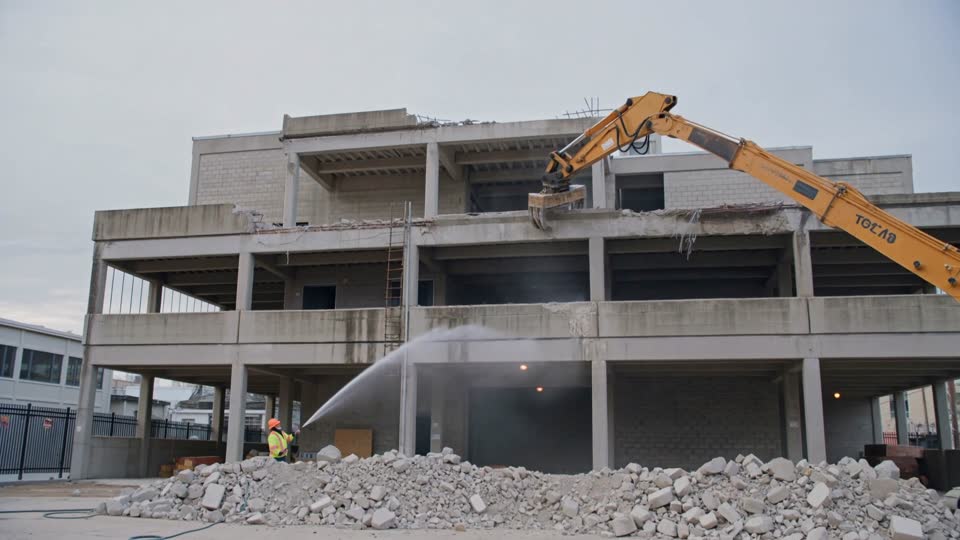
No Canadian government publishes a per-square-foot price for demolishing a house or a commercial building. What Alberta does publish are removal prices for pavement, curb and buried structures — real official proxies for the removal side of a demolition scope, even though a full building demolition is a different, larger job.
STA 0+120Why there is no published demolition price
Building demolition — houses, commercial structures, anything with a hazardous-materials profile and a foundation to break up — is not a standard highway tender item, so no provincial transportation ministry publishes an average price for it the way it does for excavation or paving. Municipal demolition permit processes vary by city, and none of the cities checked for this guide publish an average demolition cost, only permit application requirements. That leaves genuine site and pavement removal items, which Alberta does tender and price, as the closest official Canadian benchmark, covered next.
STA 0+240Official removal prices: pavement, curb and buried structures
Alberta's 2026 highway tenders price the removal side of civil work directly, which is a useful proxy for the site-clearing component of any demolition scope:
| Item | Unit | 2026 avg | Contracts | 2025 | 2024 |
|---|---|---|---|---|---|
| Asphalt Surfacing - Remove and DisposeItem X205 | m³ | $67.63 | 4 | $67.14 | $63.83 |
| Concrete Curb and Gutter - Remove and DisposeItem X215 | m | $32.60 | 1 | — | — |
| Concrete Surface - Remove and DisposeItem X220 | m² | $37.26 | 5 | $42.25 | $39.53 |
| Concrete Curb - Remove and DisposeItem X235 | m | $42.05 | 2 | — | — |
Removing and disposing of concrete surfacing averaged $37.26 per m²1 per square metre, curb and gutter removal averaged $32.60 per m1 per metre, and asphalt surfacing removal averaged $67.63 per m³1 per cubic metre. Buried structures are priced separately: removing and disposing of an existing culvert up to 700 mm diameter averaged $119.48 per metre, rising to $149.60 for larger diameters — see the culvert installation cost guide for the full removal table. None of these are building demolition prices; they are official Alberta rates for removing the pavement, curb and buried infrastructure that a demolition or redevelopment site typically also has to clear.
STA 0+360Demolition method: mechanical, selective and deconstruction
Three broad approaches cover most demolition scopes, and the method chosen changes both the cost and the timeline:
- Mechanical demolition. Excavators with shears, hammers or grapples take a structure down quickly. The lowest-cost method per square foot in most cases, and the standard approach for a straightforward teardown with no salvage requirement.
- Selective demolition. Removing specific interior elements or a portion of a structure while leaving the rest standing — common in a renovation or partial-building project, and slower and more labour-intensive per square foot than a full mechanical takedown.
- Deconstruction. Manually dismantling a structure to maximize material salvage and recycling. Slower and more labour-intensive than mechanical demolition, but can reduce disposal tipping fees and, on some projects, is required or incentivized by a municipal green-demolition program.
Dust and noise control, temporary fencing and erosion control around the site are usually priced into the contractor's mobilization rather than broken out separately, but confirm what is included before comparing two quotes that may not be scoping the same site-protection work.
STA 0+480What actually drives a building demolition quote
Without a published rate, a demolition quote is built from a specific set of drivers:
- Hazardous materials survey. Most municipalities require a designated-substances or hazardous-materials survey (asbestos, lead paint, and similar) before a demolition permit is issued for an older structure. No official survey fee is published; it is billed by private environmental consultants and its findings can add significant abatement cost before demolition itself starts.
- Structure size, type and construction. A wood-frame house, a masonry building and a structure with a full basement all demolish at different rates and with different equipment.
- Disposal and tipping fees. Demolition debris is trucked to a landfill or recycling facility and charged a tipping fee per tonne, set by each facility, not by any province-wide rate.
- Salvage and recycling value. Concrete, asphalt, metal and sometimes lumber can be recycled or sold for salvage, which can offset part of the disposal cost — the net effect depends on local scrap and recycling markets.
- Utility disconnects. Gas, power, water and sewer usually have to be formally disconnected by the utility before demolition, which can add lead time even where it adds little direct cost.
- Site restoration after. Backfilling a basement excavation and grading the lot afterward is its own line item — see the excavation and site preparation cost guides.
STA 0+600House versus commercial demolition
A single residential teardown and a commercial building demolition scale differently, beyond the obvious size difference:
- Commercial structures more often involve structural steel, larger foundations, and a higher chance of encountering designated substances that require licensed abatement before mechanical demolition can start.
- Residential teardowns in established neighbourhoods often face tighter access, closer neighbouring properties, and municipal rules about noise, dust and working hours that a rural or industrial site does not.
- Both need the permit and hazmat survey lead time factored into the schedule before physical demolition can start — this is frequently the longest part of the timeline, not the demolition itself.
Neither category has a published price, but the cost drivers scale in a predictable direction: more structure, more materials complexity and tighter access all push the number up, while a straightforward wood-frame structure on an open, accessible site with a clean hazmat survey is the fastest and lowest-cost scenario a contractor will see.
STA 0+720What to send for a price
For a comparable demolition quote: the structure's size, age and construction type, whether a hazardous-materials survey has already been done, site access for demolition equipment and disposal trucks, whether the foundation and basement (if any) should be removed or left, and what should happen to the site afterward (backfilled and graded, or left open for the next phase of construction).
Ask each contractor to confirm the same scope in writing before comparing prices: whether the hazmat survey and abatement are included or excluded, whether the foundation comes out, who pays the disposal tipping fees, and who keeps any salvage value. Two quotes that look far apart in price are frequently pricing different scopes rather than the same job at different rates.
Questions people ask
How much does demolition cost?
No Canadian government publishes a per-square-foot demolition price. Alberta's official removal-item averages give a real benchmark for pavement and curb removal — $37.26 per m²1 per square metre for concrete surfacing, for example — but a full building demolition needs a direct quote based on the structure's size, age and hazardous-materials profile.
How much does house demolition cost in Calgary or Edmonton?
Neither city publishes an average house demolition price. Cost depends on the house's size, age, foundation type and any hazardous materials found in the required pre-demolition survey. Get a direct quote after that survey is complete.
How much does demolition cost in Toronto or Vancouver?
No published figure exists for either city. Municipal demolition permit processes and hazardous-materials survey requirements vary by city; check the local building department's demolition permit requirements as the first step before pricing the work itself.
How much does it cost to demolish a house in B.C.?
No official B.C. figure was found. B.C.'s only published demolition-adjacent civil figures are provincial highway removal items from the 2013 cost guide, not a residential demolition price; get a local contractor quote after a hazardous-materials survey.
What is demolition cost per square foot, including commercial?
No official per-square-foot rate is published for residential or commercial demolition in Canada. Structure type, hazardous materials findings, and local disposal tipping fees drive the actual price more than square footage alone; see "What actually drives a building demolition quote" above.
How much does a demolition permit cost, and is there a demolition cost calculator?
Permit fees are set by each municipality and were not found published in a comparable national format for this guide; check directly with the local building department. No demolition cost calculator exists on this site or elsewhere that accounts for hazardous-materials findings, which are the biggest source of cost variation in a real quote.
Sources
- Unit Price Averages (workbook updated 2026-06-24)Alberta Transportation and Economic Corridors · 2026
Related
-
 K-301
Excavation cost
Per cubic metre on tendered work, per hour for equipment, and what changes the number on a small job.
K-301
Excavation cost
Per cubic metre on tendered work, per hour for equipment, and what changes the number on a small job.
-
 K-302
Cost to build a road
What a kilometre of road costs, layer by layer, from gravel lease roads to paved highway.
K-302
Cost to build a road
What a kilometre of road costs, layer by layer, from gravel lease roads to paved highway.
-
 K-303
Asphalt paving cost
Hot-mix by the tonne, paving by the square metre, and milling, overlays and parking lots.
K-303
Asphalt paving cost
Hot-mix by the tonne, paving by the square metre, and milling, overlays and parking lots.