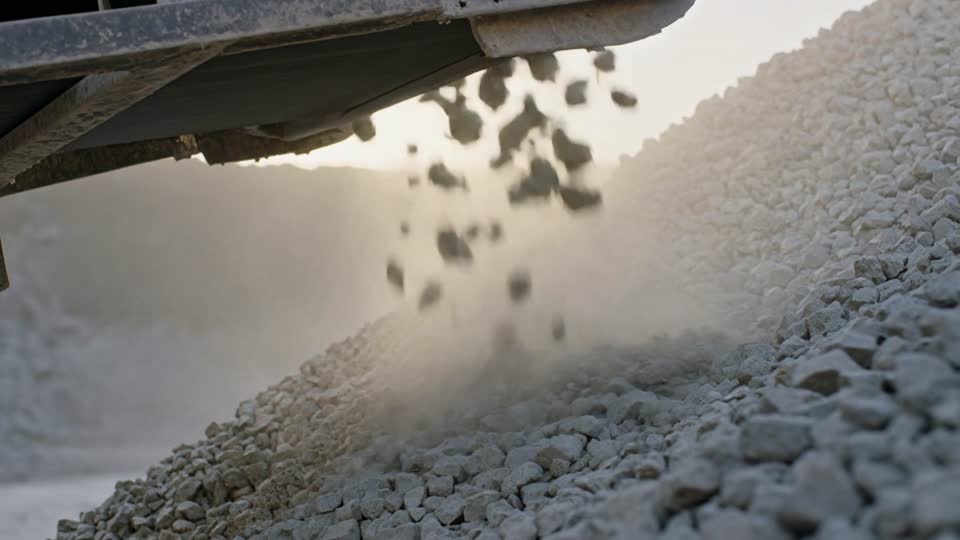
Cost guide · Sheet K-304
Gravel cost per tonne in Canada
"Gravel" covers a range of products priced very differently: raw pit run, crushed and graded base course, and a finished surfacing gravel spec for the top of a road. Alberta is the only province that publishes bid averages for all three, tendered by the tonne.
STA 0+120Gravel is not one product
A gravel price is meaningless without knowing which product it is pricing:
- Pit run. Aggregate as it comes out of the pit, unscreened and unwashed. The lowest-cost form of the material, and the least controlled for gradation.
- Crushed and screened base course. Aggregate processed to a specified gradation (Alberta's Design 2 or Design 4 classes, for example) so it compacts predictably under a road or pad. This is what most people mean by "road gravel."
- Surfacing gravel. A tighter-graded product meant to be the finished driving surface of a gravel road, not covered by asphalt. It costs more per tonne than base course because it has to resist rutting and washboarding on its own.
The full range of pit, crushing and gradation specs is covered in the aggregates and gravel discipline page. This guide is about what each grade actually costs.
STA 0+2402026 prices, per tonne
Alberta Transportation and Economic Corridors publishes the average of the three lowest bids on every aggregate item it tenders, across contracts tendered May 1, 2025 to June 24, 2026:
| Item | Unit | 2026 avg | Contracts | 2025 | 2024 |
|---|---|---|---|---|---|
| Supply of Aggregate - With OptionItem A800 | t | $3.27 | 16 | — | — |
| Supply of Aggregate - No OptionItem A805 | t | $1.29 | 14 | — | — |
| Granular Base CourseItem B281 | t | $26.75 | 1 | — | — |
| Granular Base Course - Des. 2 Cl. 25Item B282 | t | $33.65 | 26 | $29.03 | $32.51 |
| Granular Base CourseItem B283 | t | $56.33 | 1 | — | — |
| Gravel Surfacing - Des. 4 Cl. 20Item Q185 | t | $54.90 | 4 | — | — |
| Gravel Surfacing - Des. 4 Cl. 25Item Q186 | t | $39.03 | 13 | — | — |
The gap between $1.29 per t1 (aggregate supplied with no material option, meaning the contractor is not paid separately for the pit) and $3.27 per t1 (supplied with a material option) shows how much of a "gravel price" is really the cost of the material rights and haul, not the crushing. Granular base course then adds crushing, gradation control and placement, and surfacing gravel ($54.90 per t1) adds a tighter spec on top of that. Regionally, base course price varies with the distance to a certified pit or crusher:
| Region | Avg per t | Contracts |
|---|---|---|
| Southern region | $28.37 | 4 |
| Central region | $35.07 | 13 |
| North Central region | $30.88 | 3 |
| Peace region | $41.56 | 6 |
| Province | $33.65 | 26 |
Crushing, hauling and stockpiling gravel as a standalone service item averaged $42.58 per cubic metre on 2026 Alberta tenders (item A501) — a cubic-metre figure, not a tonne figure, because that item is priced on the volume moved rather than the finished product weight.
STA 0+360Tonnes, cubic yards and cubic metres
Retail and some contractor gravel prices are still quoted per cubic yard rather than per tonne. Converting between them needs a density, which varies by material and compaction: dry gravel runs roughly 1,600 to 1,780 kg per compacted cubic metre as a planning value from a U.S. Army field-manual density table2, meaning a cubic metre of gravel weighs somewhere around 1.6 to 1.8 tonnes. Use the gravel and aggregate tonnage calculator rather than a rule of thumb for a specific job, since actual density depends on the material and how well it is compacted.
STA 0+480Why a small delivered load costs more per tonne
Alberta's averages are for tens or hundreds of thousands of tonnes moved on a single highway contract. A homeowner, landscaper or small contractor buying a few tonnes pays a different structure entirely:
- Minimum loads. Most pits and gravel yards sell by the truckload with a practical minimum, not by the single tonne.
- Delivery distance. Haul is priced separately from the material in almost every retail gravel quote, and it is usually the larger part of the delivered price once you are more than a few kilometres from the pit.
- Pickup versus delivered. Picking up gravel yourself in a trailer avoids the delivery charge but adds your own vehicle's weight limits and trips.
- City and regional pricing. No official body publishes retail gravel prices for Calgary, Edmonton or any other city; the Alberta figures above are provincial highway-tender averages, not local yard prices, and yard prices are set independently by each supplier.
Treat the Alberta tender prices as a floor and a sanity check on the material cost inside a larger quote, not as what a small delivered load should cost.
STA 0+600What else moves the price beyond the grade
Two factors move a gravel price more than the grade name on the invoice:
- Haul distance to the pit. Aggregate is heavy and low-value per tonne relative to its weight, so it is not economical to haul far. A project near an active pit or crusher pays close to the material cost; a project in a region without local aggregate pays a haul premium that can exceed the cost of the material itself. This is why Alberta's own regional averages above swing by more than 45% between regions in the same province.
- How much crushing and screening the product needs. Pit run needs none. A tight-graded base course or surfacing product needs the pit's raw material crushed, screened into size fractions and blended back to spec, which adds a processing cost on top of the raw material.
- Specification versus general fill. Gravel bought to meet an engineered gradation specification, with test results to back it up, costs more than the same-looking material sold as general fill with no quality documentation attached. If a project needs the material to perform structurally (under a road, a pad or a foundation), ask for gradation test results, not just a visual match to "3/4 inch minus" or similar.
STA 0+720Outside Alberta
No other Canadian province publishes an average bid price for aggregate supply. Ontario, British Columbia, Saskatchewan and Manitoba's highway agencies either keep bid results out of the public record or publish no summary report at all. Where a national comparison is needed, the Alberta figures above are the only sourced government benchmark currently available; treat gravel prices in other provinces as needing a local quote rather than a published rate.
STA 0+840What to send for a price
To get a firm delivered or supplied price:
- The grade needed: pit run, a specific base-course class, or surfacing gravel.
- The quantity, in tonnes or cubic metres, and whether it is compacted or loose volume.
- Delivery address and access for a gravel truck, or confirmation you are picking up.
- Whether the material needs to meet a specification (for a road, pad or drainage layer) or is for general fill.
The gravel and aggregate tonnage calculator converts an area and depth into the tonnes to ask for, which keeps quotes from different suppliers comparable.
Questions people ask
How much does gravel cost per tonne?
On Alberta provincial highway tenders in 2026, raw aggregate supply averaged $1.29 per t1 to $3.27 per t1 per tonne, granular base course averaged $33.65 per t1, and gravel surfacing averaged $54.90 per t1. These are highway-scale averages; a small delivered load from a local yard costs more per tonne once haul and minimum-load pricing are added.
How much does gravel cost per ton in Alberta, Calgary or Edmonton?
No official body tracks retail gravel prices city by city. The Alberta figures above are provincial highway-tender averages, not Calgary or Edmonton yard prices; contact a local supplier for a delivered quote, and use the tender averages only as a rough check on the material-cost component.
How much does gravel cost in Ontario or other provinces?
No Canadian province other than Alberta publishes an average aggregate bid price. Ontario, British Columbia, Saskatchewan and Manitoba gravel prices need a local supplier quote; there is no published government benchmark to check them against outside Alberta.
How much does a load of gravel or crushed gravel cost delivered?
Delivered price depends on quantity, grade and distance from the pit, and is set by the supplier, not by any government rate. Ask for a price per tonne delivered, and use the gravel and aggregate tonnage calculator to check the tonnage matches what your project actually needs.
What is the difference between crushed stone cost and gravel cost?
Both are aggregate, graded differently. Crushed stone is angular, mechanically crushed material; gravel is naturally rounded. Alberta's tendered granular base and surfacing items above are crushed and graded products regardless of the marketing name a supplier uses.
How much gravel do I need, and what does it cost per cubic yard?
Use the gravel and aggregate tonnage calculator to convert an area and depth into tonnes or cubic metres. A compacted cubic metre of dry gravel weighs roughly 1,602 to 1,780 kg as a typical planning value2; convert to cubic yards at about 0.765 cubic metres per cubic yard before comparing a per-yard quote to the per-tonne figures on this page.
Sources
- Unit Price Averages (workbook updated 2026-06-24)Alberta Transportation and Economic Corridors · 2026
- FM 5-434 Earthmoving Operations, Chapter 1, Tables 1-1 and 1-2U.S. Department of the Army (field manual; hosted copy on GlobalSecurity.org) · FM 5-434 (2000)
Related
-
 K-301
Excavation cost
Per cubic metre on tendered work, per hour for equipment, and what changes the number on a small job.
K-301
Excavation cost
Per cubic metre on tendered work, per hour for equipment, and what changes the number on a small job.
-
 K-302
Cost to build a road
What a kilometre of road costs, layer by layer, from gravel lease roads to paved highway.
K-302
Cost to build a road
What a kilometre of road costs, layer by layer, from gravel lease roads to paved highway.
-
 K-303
Asphalt paving cost
Hot-mix by the tonne, paving by the square metre, and milling, overlays and parking lots.
K-303
Asphalt paving cost
Hot-mix by the tonne, paving by the square metre, and milling, overlays and parking lots.