Discipline · Sheet C-114
Municipal infrastructure
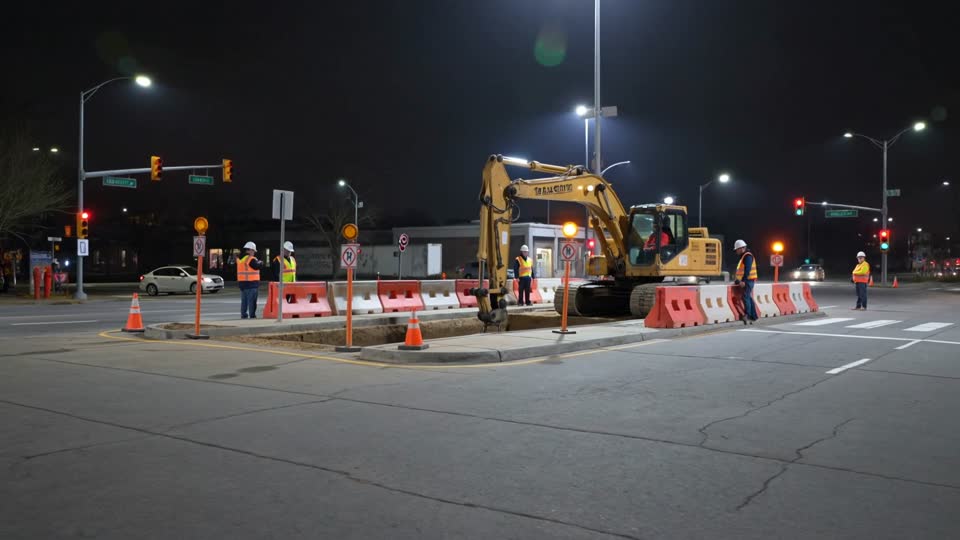
Most of the roads and pipes Canadians use every day belong to a municipality, not a province or the federal government, and each city writes and tenders its own specification for building and fixing them.
A watermain break, a pothole, a stormwater pond: almost all of it belongs to a municipality. Local and regional governments own the majority of Canada's road and pipe infrastructure by value, which means most of the day-to-day civil construction market runs on municipal specifications and municipal tenders rather than a single national standard.
STA 0+120What "municipal infrastructure" covers
This page is about how municipalities buy and maintain civil infrastructure, not a new set of construction techniques: the underlying work is the same roadbuilding, underground utilities and concrete covered on their own discipline pages. What is different is the owner. A municipality:
- writes and publishes its own standard specifications and drawings, rather than relying only on a provincial highway spec;
- tenders most of its own construction and renewal work through its own or a shared municipal portal;
- owns most of the local road and underground network by value, and carries the renewal backlog that comes with an aging network; and
- charges its own restoration and permit rates when a utility or contractor cuts into its roads.
See roadbuilding and paving and underground utilities for the construction detail, and snow and winter works for how winter changes municipal maintenance.
STA 0+240How municipalities specify their work
Rather than one national municipal specification, Canada has a handful of regional systems that most cities adopt, adapt or reference:
- Ontario Provincial Standards (OPSS/OPSD). Developed jointly by the Ontario Ministry of Transportation, the Municipal Engineers Association and the Ministry of the Environment, published twice a year and free to use, though adoption by a given municipality is not mandatory1. Many Ontario municipalities issue their own amendments on top of OPSS.MUNI, the municipal variant.
- Master Municipal Construction Documents (MMCD). A shared specification and contract-document system used across British Columbia municipalities, currently on its 2019 Platinum edition with periodic updates2.
- City-specific standards. Larger cities publish their own standard specifications directly. Calgary maintains separate current specifications for waterworks and sewer construction, both on a 2025 edition33, and its own 2021-edition road construction specification4. Edmonton publishes Complete Streets design and construction standards5, and Toronto maintains its own construction specifications and standard drawings for road works, many of which amend the Ontario provincial standards rather than replacing them6.
A contractor working across more than one city needs to check which system, and which edition, applies to a given tender: the same pay item name can carry a different test method or acceptance criterion from one municipality's specification to the next.
STA 0+360How municipal work is tendered
The federal open-data tender feeds used elsewhere on this site cover federal government contracts only, even though the CanadaBuys portal itself lists tenders from other levels of government7. Municipal tenders are instead posted on the municipality's own website or on a shared municipal e-bidding platform such as bids&tenders8 or Biddingo8, and some are distributed through the private MERX network8 alongside provincial and federal notices. See bidding on public tenders for how to read a municipal tender package, and the live tender feed for what is open now.
STA 0+480Ownership and condition of the network
Statistics Canada's Core Public Infrastructure Survey puts a number on both questions. Local and regional governments own 72 percent of Canada's transportation and water infrastructure by replacement value, and 64 percent of road replacement value specifically99. That ownership comes with the condition problem: road infrastructure with an estimated replacement value of $250.2 billion is rated poor or very poor9, and water infrastructure worth $106.5 billion is in the same condition9. The survey is refreshed roughly every two years, with 2022 the latest reference year found at the time of writing10.
That backlog is the practical argument behind most municipal renewal programs: replacing a watermain or reconstructing a road before it fails is generally cheaper than emergency repair after it does, which is why so much of the civil tender volume in an established city is renewal and rehabilitation rather than new construction. A pipe or a road segment does not fail all at once; the survey rates an asset very poor once less than 10 percent of its expected service life remains, poor below 40 percent, good at 80 percent or more, and very good at 95 percent or more11, which is why a municipality's renewal program is usually built around a ranked list of assets rather than a single citywide replacement date.
STA 0+600What cities charge to restore a cut
When a utility or contractor cuts into a municipal road to install or repair something underground, the municipality typically charges a restoration or degradation fee to bring the surface back to standard, separate from the cost of the underlying construction. These are municipal charges, not contractor bid prices, and they vary significantly by city. Calgary charges an asphalt degradation fee that scales with road classification, from 12 $49.95 per square metre on a local road up to $61.15 per square metre on an arterial road, in 2026. Winnipeg charges a flat minimum plus an area rate for pavement cut restoration: $848 minimum for the first 2 square metres and $424 for each additional square metre in 202613. Edmonton takes a different approach for new subdivisions, charging an Arterial Roadway Assessment that funds the arterial network a new development draws on, averaging $299,963 per hectare for residential development city-wide in 202614.
None of these are contractor prices for doing the restoration work; they are what the city charges the permit holder, on top of whatever the contractor charges to do the physical patch. Confirm the current rate sheet for the specific municipality before pricing a job that involves a road cut.
STA 0+720Funding programs behind municipal renewal
Much of the capital behind municipal roads and pipes flows through federal transfer programs rather than the municipal tax base alone. The Canada Community-Building Fund, now the Community stream of the Build Communities Strong Fund, delivers over $2.5 billion a year to more than 3,700 communities for local infrastructure15, with $26.7 billion committed over the 10-year agreement period from 2024 to 203415. The newer Build Communities Strong Fund adds $51 billion over 10 years starting in 2026-2716, split across a Provincial and Territorial stream, a Direct Delivery stream and the Community stream, and launched its first tranche of 13 projects worth $300 million in April 202617. The Canada Housing Infrastructure Fund adds a further $6 billion aimed specifically at drinking water, wastewater, stormwater and solid waste projects that enable new housing18. See infrastructure funding programs for how these flow from application to construction.
STA 0+840What to send for a price on municipal work
A municipal civil scope that gets a firm number usually includes:
- The municipality and the specification edition the work is governed by.
- Whether the work is new construction, renewal, or a utility cut requiring restoration.
- Traffic control requirements, since municipal road work is almost always done under live traffic.
- Whether the project is tendered publicly or being priced as a private servicing job under a development agreement.
- Any known restoration or degradation fee that applies on top of the construction cost.
Ask which specification edition governs, specifically, since a municipality updating its standard mid-year (as several do with bulletins and amendments) can change a material or test requirement partway through a construction season.
Questions people ask
Who owns most of the roads and pipes in Canada?
Does every city use the same construction specification?
No. Regional systems like Ontario's OPSS and British Columbia's MMCD are widely used but not mandatory, and larger cities such as Calgary, Edmonton and Toronto publish their own specifications and standard drawings, sometimes amending a regional system rather than replacing it.
What does a city charge to restore a road after a utility cut?
It varies by municipality: Calgary's 2026 asphalt degradation fee ranges from $49.95 to $61.15 per square metre depending on road class12, and Winnipeg charges an $848 minimum plus $424 per additional square metre for pavement cut restoration in 202613. These are city charges, separate from the contractor's price to do the physical patch.
How much of Canada's municipal infrastructure needs replacing?
Where can I find open municipal construction tenders?
The federal CanadaBuys feed only carries federal notices7; municipal tenders are posted on the city's own site or on a shared platform such as bids&tenders or Biddingo. See the site's live tender feed and bidding on public tenders.
Sources
- Ontario Provincial Standards for Roads and Public Works - OPS User Guide (January 2023)Ontario Ministry of Transportation · User Guide January 2023
- Master Municipal Construction Documents AssociationMMCD Association · from search excerpts
- Water guidelines and construction specificationsCity of Calgary · dated 2025-01-01
- Road contractors and consultantsCity of Calgary · retrieved 2026-09-24
- City Design and Construction Standards / Complete StreetsCity of Edmonton · from search excerpts; edmonton.ca returned HTTP 502 on 2026-09-24
- Construction Specifications and Drawings for Road WorksCity of Toronto · retrieved 2026-09-24
- CanadaBuys tender notices (Open Government Portal dataset)Public Services and Procurement Canada · 2026-09-24
- Other tendering websitesPublic Services and Procurement Canada · page modified 2025-10-29
- The Daily - Canada's Core Public Infrastructure Survey: Replacement values, 2022Statistics Canada · 2022
- Canada's Core Public Infrastructure surveyHousing, Infrastructure and Communities Canada · retrieved 2026-09-24
- Table 34-10-0288-01 Inventory distribution of core public infrastructure assets by physical condition ratingStatistics Canada · 2022 survey footnotes
- Excavation permit rate sheetThe City of Calgary (Roads) · 2026
- 2026 pavement cut restoration feesCity of Winnipeg Public Works · 2026
- 2026 Arterial Roadway Assessment ratesCity of Edmonton · 2026
- Build Communities Strong Fund Community streamHousing, Infrastructure and Communities Canada · page modified 2026-06-23
- Build Communities Strong FundHousing, Infrastructure and Communities Canada · page modified 2026-08-13
- Prime Minister Carney launches the Build Communities Strong Fund and announces the first tranche of projectsPrime Minister's Office · 2026-04-07
- Canada Housing Infrastructure FundHousing, Infrastructure and Communities Canada · retrieved 2026-09-24
Related
-
 C-101
Earthworks & excavation
Stripping, bulk excavation, cut and fill, rock, compaction and the volumes that drive every estimate.
C-101
Earthworks & excavation
Stripping, bulk excavation, cut and fill, rock, compaction and the volumes that drive every estimate.
-
 C-102
Site servicing & land development
Water, sewer, storm and roads for new lots, and the agreements, levies and sequence that come with them.
C-102
Site servicing & land development
Water, sewer, storm and roads for new lots, and the agreements, levies and sequence that come with them.
-
 C-103
Underground utilities
Watermain, sanitary and storm sewer, manholes and services, from trench design to testing.
C-103
Underground utilities
Watermain, sanitary and storm sewer, manholes and services, from trench design to testing.