Discipline · Sheet C-113
Snow and winter works
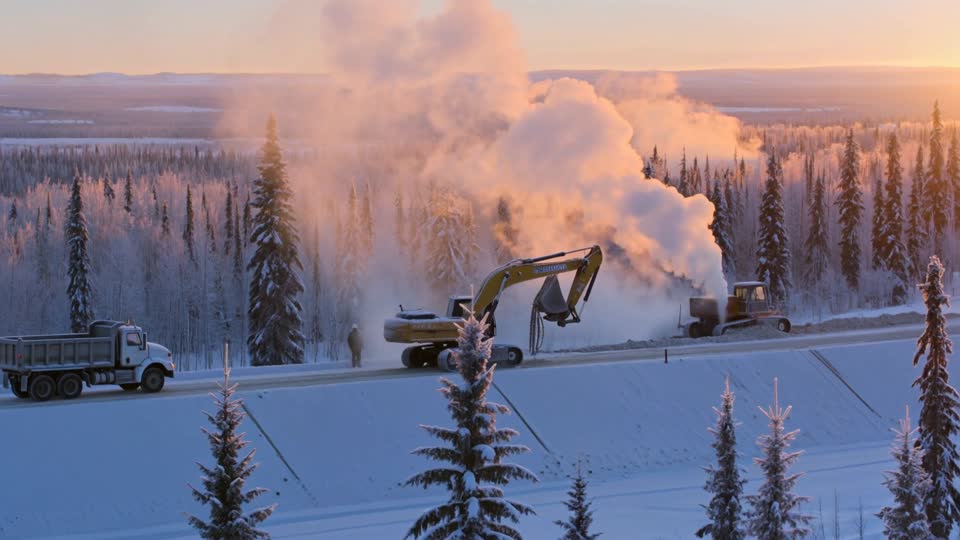
Winter does not stop Canadian civil construction, but it changes almost every step of it: the ground has to be thawed or ripped instead of dug, concrete has to be kept warm instead of just placed, and by spring the same haul roads may be closed to the loads that built them.
A Canadian construction season does not simply pause from November to April. Utility work, foundations and some earthworks continue through winter on many projects, on a schedule that has to account for frozen ground, cold concrete and the equipment and heating that both require. The trade-off is straightforward: winter work usually costs more per unit of production, in exchange for keeping a schedule that cannot wait for spring.
STA 0+120What changes about a job in winter
Winter affects nearly every civil trade, but four issues come up on almost every cold-weather job:
- Frozen-ground excavation. The top layer of soil freezes solid and has to be broken up before an excavator or trencher can work it.
- Ground thaw. Where frozen ground has to be excavated to grade below the frost line, or where a foundation needs unfrozen bearing soil, the ground may need to be actively thawed first.
- Cold-weather concreting. Concrete needs a minimum temperature to cure properly and gain strength before it can safely freeze.
- Winter roads and snow management. Site access, haul roads and public roads all behave differently under snow and ice, and in spring, thaw closes some of those same roads to heavy loads.
See winter construction for a broader process guide; this page focuses on the technical rules and the seasonal restrictions themselves.
STA 0+240Frozen-ground excavation
Frost penetrates from the surface down, so the first tens of centimetres to a metre or more of ground can freeze into a layer far harder to dig than the unfrozen soil beneath it, depending on air temperature, snow cover and soil type. Contractors generally handle this in one of a few ways: ripping the frozen crust with a dozer or excavator-mounted ripper before digging, using a heavier excavator with a frost-rated bucket and tooth package, or removing snow cover early in the season (snow acts as insulation, so keeping an area clear can reduce how deep it freezes). None of these methods have a single "typical" cost premium that applies everywhere, since the premium depends on how deep and how hard the frozen layer actually is on a given day, which is a site condition rather than a fixed rate.
STA 0+360Ground thaw
Where frozen ground must be removed to reach unfrozen bearing soil, or where a utility trench has to go below the frost line, the ground is sometimes thawed ahead of excavation rather than ripped. Thawing methods include insulated ground blankets left in place for days before digging, and mechanical or fuel-fired ground-thawing equipment that applies heat directly to the surface. Thawing is slower than ripping but disturbs the underlying soil less, which matters where the specification calls for undisturbed bearing material. As with frozen-ground excavation, how long thawing takes and what it adds to a schedule depends on depth of frost, soil type and equipment, not a fixed rule of thumb.
STA 0+480Cold-weather concreting
CSA A23.1, the Canadian concrete standard, defines cold weather as any time there is a probability of the air temperature falling below 5°C within 24 hours of placing, based on the nearest official weather forecast1. Once that threshold is in play, the standard sets minimum concrete temperatures at placing that depend on the thickness of the section: thin sections need to be placed warmer than thick ones, because they lose heat faster. As a general reference, the standard's tables call for a minimum placing temperature of 10°C for thinner sections and 5°C for the thickest sections it covers1, with maximum temperatures set as well to avoid other problems.
After placing, cold-weather protection has to keep the concrete at a minimum of 10°C for the duration of the curing period, and the concrete generally needs to reach about 7 MPa of strength before it can safely be exposed to freezing1. In practice this means insulated blankets, heated enclosures, or heated aggregates and water going into the mix, chosen based on section size, ambient temperature and how long protection needs to stay in place.
Not engineering advice
This section summarizes CSA A23.1's general cold-weather provisions. The mix design, protection method and duration for a specific pour are an engineering and quality-control decision, not a general rule; follow the project specification and the standard itself.
STA 0+600Winter roads and spring road bans
Snow and ice change how a haul road or site access performs, and every province eventually reverses that with a spring weight restriction once the thaw starts, to protect road structures softened by meltwater trapped under a still-frozen base. The triggers and the size of the reduction vary by province:
| Province | Trigger or mechanism |
|---|---|
| Alberta | Weather-dependent, based on thaw depth readings of at least 25 cm; provincial road ban line and published list2 |
| Saskatchewan | Phased-in start dates by region; allowable weights on affected roads cut by roughly 10 to 15 percent for up to six weeks3 |
| Manitoba | Two restriction levels, capping loads at 90 percent or 65 percent of legal axle weights depending on the highway class and climate zone44 |
Ontario runs a related but separate system of reduced load periods, capping the load on a designated highway's axle at 5,000 kg during the restricted period, published live for the current season5. See spring road bans for the full province-by-province picture, since a haul plan built in February can be illegal in April without warning if it is not checked against the current ban list.
STA 0+720Snow hauling and site management
On an active urban site, accumulated snow often has to be pushed, piled and eventually hauled off site to keep access, laydown areas and excavations usable. How that is priced depends entirely on the site: how much area needs clearing, where snow can be piled on site before it has to be trucked away, and how far the nearest legal snow disposal site is. There is no standard published rate for snow hauling comparable to the highway unit prices used elsewhere on this site, so it is generally priced per job or per storm event rather than by a fixed per-tonne or per-load figure.
STA 0+840Locate lead times in winter
One-call locate programs run year-round, with the same standard notice periods regardless of season: commonly three to five full working days in Alberta6, three business days in British Columbia7, and similar windows in most other provinces. What changes in winter is not the notice period but the physical marking: paint does not always show well on snow-covered ground, and locators may use stakes or flags instead, or need snow cleared from the area first. Build in extra time for the ground condition, not just the standard notice period, when planning winter excavation near buried utilities; see call before you dig.
STA 0+960What to send for a price
A winter-work brief that gets a realistic number usually includes:
- The work window: specific dates, since frost depth and daylight both change quickly across a Canadian winter.
- Whether frozen ground or ground thaw is expected, and to what depth if known.
- Concrete section sizes and pour volumes, if concrete is involved, so cold-weather protection can be planned and priced.
- Site access and snow storage or removal needs.
- Whether locates have already been requested, and how far in advance.
Ask how the quote treats weather-related standby, since a cold snap or a snowstorm can stop winter work in ways that would not affect the same job in July, and who carries that risk is worth settling before the job starts, not after.
Questions people ask
Can you excavate frozen ground in Canada?
Yes, but it costs more: frozen ground is typically ripped with a dozer or excavator before digging, or thawed ahead of time with insulated blankets or ground-thawing equipment. How much more depends on the depth and hardness of the frozen layer on a given site and day.
What temperature is too cold to pour concrete?
CSA A23.1 treats any placement with a forecast air temperature below 5°C within 24 hours as cold weather1, which triggers minimum concrete temperature and protection requirements rather than stopping work outright. Concrete can be placed well below freezing air temperatures with the right mix and protection.
When do spring road bans start in Alberta?
Alberta's spring road bans are weather dependent rather than calendar dependent, triggered by thaw depth readings of at least 25 cm2, so the start date moves with the actual thaw each year. Check the province's published road ban list rather than assuming a fixed date.
Do utility locate notice periods change in winter?
The standard notice periods stay the same year-round, such as three to five full working days in Alberta6. What changes is how long the physical marking takes, since paint and flags are harder to place and see on snow-covered ground.
How is snow hauling priced on a construction site?
There is no standard published rate; it depends on the site area, on-site storage capacity and the distance to a legal snow disposal site, and is usually priced per job or per storm rather than by a fixed unit rate.
Sources
- Cold Weather Concreting technical specification (reproduces CSA A23.1:24 with CSA Group permission)Ready Mixed Concrete Association of Ontario (citing CSA A23.1:24) · CSA A23.1:24; RMCAO document Nov/Dec 2024
- Road restrictions and bansGovernment of Alberta · retrieved 2026-09-24
- Secondary Highways in Southern Saskatchewan to Begin Spring Weight Restrictions Friday to Protect InfrastructureGovernment of Saskatchewan · 2026-03-19
- Manitoba's Spring Road Restriction (SRR) ProgramGovernment of Manitoba · retrieved 2026-09-24
- Highway Traffic Act, R.S.O. 1990, c. H.8, s. 122 Reduced load periodsGovernment of Ontario (e-Laws) · current to 2026-09-21
- Notification ProcessUtility Safety Partners · retrieved 2026-09-24
- Click or call before you dig (WorkSafeBC toolbox meeting guide) and BC 1 Call support pagesBC 1 Call / WorkSafeBC · retrieved 2026-09-24 (BC 1 Call support page not directly fetchable; from search excerpts)
Related
-
 C-101
Earthworks & excavation
Stripping, bulk excavation, cut and fill, rock, compaction and the volumes that drive every estimate.
C-101
Earthworks & excavation
Stripping, bulk excavation, cut and fill, rock, compaction and the volumes that drive every estimate.
-
 C-102
Site servicing & land development
Water, sewer, storm and roads for new lots, and the agreements, levies and sequence that come with them.
C-102
Site servicing & land development
Water, sewer, storm and roads for new lots, and the agreements, levies and sequence that come with them.
-
 C-103
Underground utilities
Watermain, sanitary and storm sewer, manholes and services, from trench design to testing.
C-103
Underground utilities
Watermain, sanitary and storm sewer, manholes and services, from trench design to testing.