Guide · Sheet G-410
Building through a Canadian winter
Canadian civil work does not stop for winter, but almost everything about how it is done changes: concrete needs protection, ground needs thawing before it can be dug, and every schedule needs slack it did not need in July.
Winter does not stop a Canadian civil site so much as it adds a second set of rules on top of the normal ones. Concrete needs a heated tent or blankets instead of open air, frozen ground needs to be thawed or ripped before it can be excavated at all, and a schedule built on summer productivity numbers will run behind by December. None of this is exotic; it is just planned for, or it is not.
STA 0+120What actually changes in winter
- Concrete needs its temperature managed from batching through curing, not just poured and left.
- Excavation in frozen ground needs the frost layer thawed, ripped or broken before a bucket can move it at a normal rate.
- Daylight shrinks to a few productive hours in northern latitudes, cutting into the working day regardless of temperature.
- Site access and haul roads can improve on frozen, snow-packed ground in some conditions and become impassable in others, which is also why winter is when some remote sites do their heaviest hauling.
- Costs rise for heating, hoarding, snow clearing and lower crew productivity, even when the work itself has not changed.
See snow and winter works for the discipline overview and spring road bans for what happens on the other side of winter, when frozen ground thaws and road weight limits drop.
STA 0+240Cold-weather concrete rules
CSA A23.1, Canada's concrete standard, defines cold weather as any time there is a probability of the air temperature falling below 5°C within 24 hours of placing, based on the forecast from the nearest official meteorological office1. Once that threshold is met, the standard sets minimum concrete temperatures at placing by section thickness: 10°C for sections under 1 m thick, dropping to 5°C for sections 2 m thick or more1. That temperature then has to be maintained through the curing period — a minimum of 10°C for the duration of curing — and the concrete has to reach a minimum compressive strength of 7 MPa before it can safely resist early frost damage1.
In practice this means heated enclosures or insulating blankets, temperature monitoring rather than a guess, and a curing plan that accounts for how long the mix actually takes to reach 7 MPa at the temperature it is being held at, which is slower than the same mix curing in summer conditions. See concrete and flatwork for the broader discipline and civil concrete cost for how winter protection affects pricing.
STA 0+360Excavating frozen ground
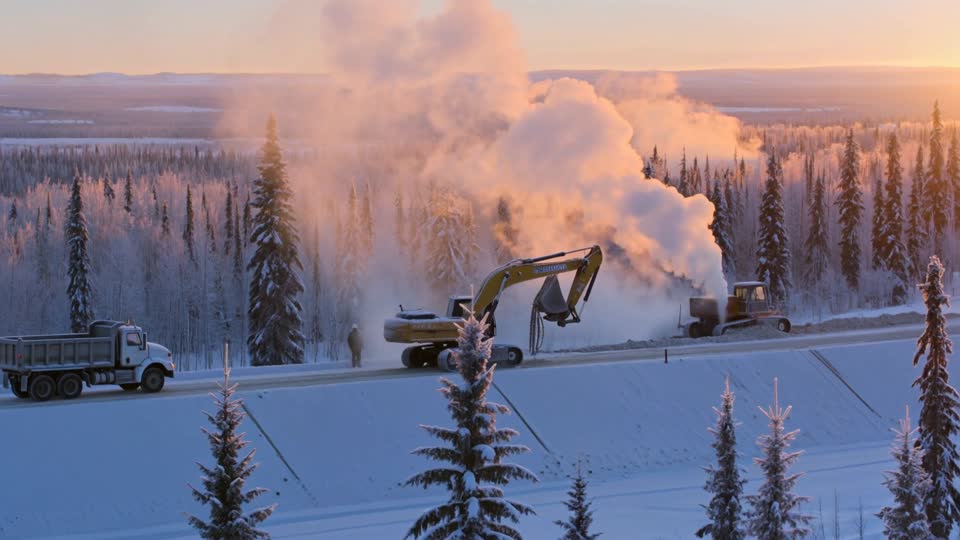
Frozen ground behaves closer to soft rock than soil: a bucket that cuts clay easily in summer can bounce off the same clay once it is frozen a few centimetres deep. Contractors deal with this three ways: ripping with a dozer or excavator-mounted ripper where the frost is shallow, mechanical breaking for a thicker frozen crust, or thawing the ground ahead of the dig with insulating blankets, ground-thaw units or, on some sites, propane-fired thaw boxes. Which method makes sense depends on how deep the frost has penetrated and how much area needs to be opened; a small utility repair might just get broken through, while a subdivision-scale strip needs a planned thaw sequence ahead of the excavation crew. See earthworks and excavation for how frozen material is measured and priced differently from the same soil unfrozen.
STA 0+480How deep does the frost actually go?
This is a harder question to answer with a single number than it looks. Frost penetration depends on air temperature over the whole winter (the freezing index), snow cover, soil type and moisture, and it varies significantly by region and by year. The most detailed Canadian government guidance found in this research is a 1976 National Research Council digest describing frost depth qualitatively — from a few inches in milder areas to several feet in colder ones — without a current, authoritative national frost-depth map or a set of current city-by-city figures. Anyone relying on a specific frost-depth number for a design, such as footing depth below the frost line, should get it from a current geotechnical report or the local building code's frost depth requirement for that municipality, not a general figure.
STA 0+600Scheduling around winter, not against it
- Sequence concrete pours for daylight and temperature where possible; an early pour has more hours to reach initial set before the coldest part of the night.
- Order thaw and heating equipment ahead of the cold, not once a schedule is already behind because ground could not be opened.
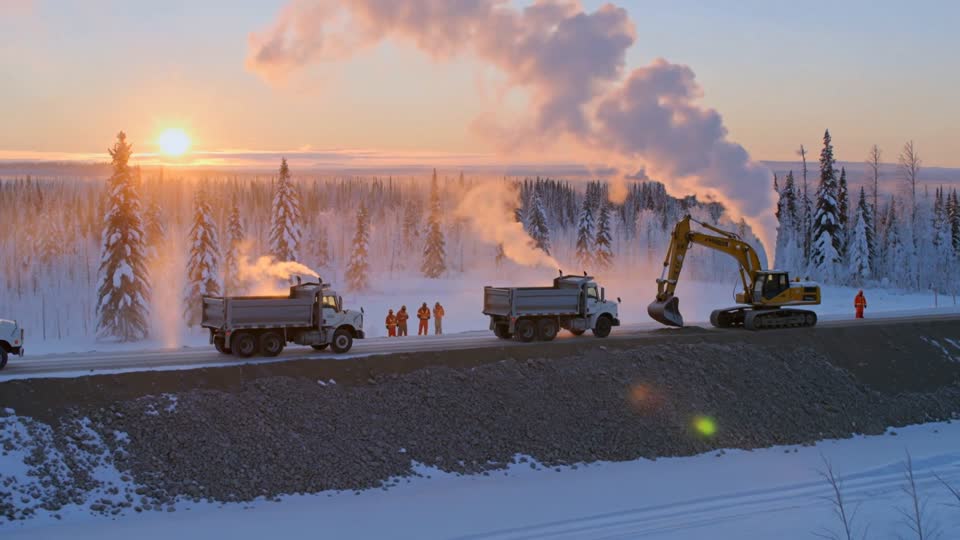
- Plan haul-heavy work for winter where the ground supports it, and shift it out of the spring window covered in spring road bans, when the same frozen ground that helped haul roads in January turns into a weight-restricted mess in April.
- Budget for lower productivity, not just added heating cost. Shorter daylight, more setup and teardown of temporary heat, and slower cure times all reduce the units a crew moves per day compared with summer.
STA 0+720What winter adds to the price
Nothing about winter work is free. Hoarding and temporary heat, ground-thaw equipment rental, extended cure times that hold formwork and crews on site longer, and reduced daily production all show up in a winter quote even when the scope of work has not changed from a summer job. A contractor pricing winter work is not padding the number by including these; they are real costs that a summer-based unit price does not carry. Ask a contractor to separate the winter-specific line items (heating, hoarding, ground thaw) from the base scope on a quote, so it is clear what is driving the premium and what would disappear if the same job ran in July instead.
STA 0+840Snow removal and site access
Keeping a winter site workable is its own line item, separate from the construction scope itself. Haul roads and laydown areas need to be plowed and, once packed snow turns to ice, sanded or otherwise treated before equipment and trucks can move safely. On an active earthworks or servicing job, snow clearing is not a one-time event before work starts; it is a recurring task through the whole season, and a site that has not budgeted for it can lose more productive time to an unplowed haul road than to the cold itself. See snow and winter works for how snow hauling and site access are typically scoped separately from the underlying civil work.
STA 0+960Materials besides concrete
Concrete gets most of the attention because CSA A23.1 sets explicit numbers for it, but other materials have their own cold-weather handling needs. Granular material that is frozen in stockpile or in a truck box can arrive as chunks rather than a workable gradation, which affects compaction. Asphalt paving is generally avoided once ambient and surface temperatures drop too far, because the mat cools and loses workability before it can be compacted to spec; most paving programs effectively shut down for the coldest months and resume once ground and air temperatures recover. Pipe and fittings stored outside can become brittle in extreme cold, which is a handling issue on site as much as a design one. None of these are complicated to manage, but each needs to be planned for rather than discovered mid-pour or mid-lift.
Questions people ask
What temperature triggers cold-weather concrete rules in Canada?
CSA A23.1 defines cold weather as any time the forecast shows a probability of air temperature falling below 5°C within 24 hours of placing1.
Can you excavate frozen ground?
Yes, but not at a normal rate: frozen ground is typically ripped, mechanically broken, or thawed ahead of the dig with insulating blankets or ground-thaw units, depending on how deep the frost has penetrated.
What minimum temperature does concrete need at placing in winter?
10°C for sections under 1 m thick, down to 5°C for sections 2 m thick or more, under CSA A23.1 Table 141.
How deep does frost go into the ground in Canada?
It varies by region, snow cover and soil moisture, and no current authoritative national frost-depth map was confirmed in this research. Use a current geotechnical report or the local building code’s frost depth requirement for a specific site rather than a general figure.
Why does winter construction cost more?
Heating and hoarding for concrete, ground-thaw equipment, longer cure times that hold crews and formwork on site, and lower daily productivity from shorter daylight all add real cost even when the scope has not changed from a summer job.
Sources
- Cold Weather Concreting technical specification (reproduces CSA A23.1:24 with CSA Group permission)Ready Mixed Concrete Association of Ontario (citing CSA A23.1:24) · CSA A23.1:24; RMCAO document Nov/Dec 2024
Related
-
 G-401
Call before you dig
One-call centres by province, notice periods, what the paint means and what to do when marks are missing.
G-401
Call before you dig
One-call centres by province, notice periods, what the paint means and what to do when marks are missing.
-
 G-402
Trench safety & shoring
How deep you can dig without protection in every province, and the sloping, shoring and box rules.
G-402
Trench safety & shoring
How deep you can dig without protection in every province, and the sloping, shoring and box rules.
-
 G-403
Spring road bans
Why thaw closes roads to heavy loads, how Alberta, Saskatchewan, Manitoba and Ontario set them, and how to plan around them.
G-403
Spring road bans
Why thaw closes roads to heavy loads, how Alberta, Saskatchewan, Manitoba and Ontario set them, and how to plan around them.