Discipline · Sheet C-108
Concrete and flatwork
Curb, gutter, sidewalk and concrete pavement are a small share of a project’s volume next to earthworks or paving, but they are the part the public touches every day, and the part cold weather is quickest to ruin if the rules are ignored.
Civil concrete flatwork covers everything cast flat or near-flat in place at the roadside: curb and gutter, sidewalk, barriers, medians and, on higher-traffic or heavy-load roads, the pavement itself. It is finished to a tighter surface tolerance than most other civil work because people walk and drive on it directly, and it is one of the few trades on this site where the weather itself, not just the schedule, can force a stop.
STA 0+120What concrete flatwork covers
On a typical road or servicing project, concrete flatwork includes:
- Curb and gutter. Formed or slip-formed concrete defining the edge of the road and channelling runoff to a catch basin.
- Sidewalk. Either separate from the curb or built monolithically (poured together with the curb and gutter in one continuous section).
- Barriers. Concrete barrier walls separating traffic from a hazard, an opposing lane, or a drop-off.
- Medians and swales. Shaped concrete or grassed sections that separate traffic or carry drainage, built to the same grading logic as lot grading but finished in concrete where traffic or maintenance demands it.
- Concrete pavement. Full-depth Portland cement concrete (PCC) pavement, used instead of asphalt on some heavy-load or high-durability roads.
STA 0+240Curb, gutter and sidewalk
Curb and gutter can be formed and poured by hand or, on longer runs, extruded continuously by a slip-form paver that moves along the alignment as it places concrete. Alberta's 2026 highway averages for the main configurations:
| Item | Unit | 2026 avg | Contracts | 2025 | 2024 |
|---|---|---|---|---|---|
| Curb and GutterItem X325 | m | $183.00 | 5 | $238.70 | $156.15 |
| Monolithic Sidewalk, Curb and GutterItem X310 | m | $416.14 | 3 | $450.44 | $346.21 |
| Concrete CurbItem X320 | m | $175.24 | 3 | $188.01 | — |
Monolithic sidewalk, curb and gutter (poured as one continuous section) costs more per metre than curb and gutter alone, since it is a wider, thicker section of concrete, but it removes one cold joint between the sidewalk and the curb and can go in faster than pouring the two separately. Plain concrete curb without an attached gutter is used where the road already has a separate drainage system, such as a rural cross-section with ditches instead of catch basins.
STA 0+360Barriers, medians and swales
Concrete barrier separates opposing traffic or shields a roadside hazard, and it is designed and tested to redirect a vehicle rather than simply stop it; on Alberta highway contracts it averages $548.52 per m1. Medians and swales are shaped to move water, not just separate lanes, and whether they are concrete, grassed or a mix depends on maintenance access, the volume of runoff they need to carry, and how much width the right-of-way allows. A concrete swale holds its shape and resists erosion better than a grassed one but costs more to build and is harder to modify later if the drainage plan changes. Barrier is also specified by the crash test level it has been designed and tested to, not by its shape alone, so two barrier walls that look similar on a drawing can carry very different capacities depending on what vehicle and speed they were designed to redirect.
STA 0+480Portland cement concrete pavement
Full-depth concrete pavement is a different structural choice from asphalt, not just a different surface: it spreads load through the slab itself, resists rutting from slow, heavy or channelized traffic (bus lanes, truck routes, intersections), and lasts longer before major rehabilitation, at a higher first cost. On Alberta highway contracts it averages $445.18 per m²1. Concrete pavement is jointed to control where it cracks: contraction joints are cut or formed at regular intervals so the slab shrinks predictably along those lines instead of cracking randomly, and dowels or tie bars transfer load and keep adjoining slabs aligned across a joint. See roadbuilding and paving for how the same road structure is built with an asphalt surface instead.
STA 0+600How flatwork is formed, finished and cured
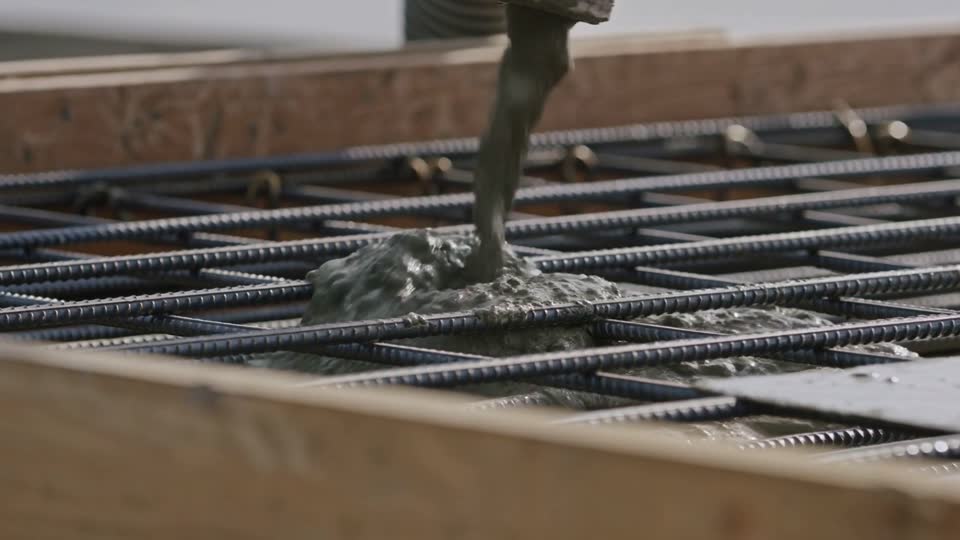
Concrete flatwork follows the same broad sequence regardless of the element: forms are set to line and grade, reinforcing steel or dowels are placed where the design calls for them, concrete is placed and consolidated, the surface is finished (a broom finish for sidewalk and pavement, a smoother finish for barrier faces), and joints are cut or tooled while the concrete is still workable. Curing then holds enough moisture in the surface for the cement to keep hydrating; concrete that dries out too fast cures weaker at the surface and is more likely to crack and scale, whatever the weather.
Air content matters as much as strength for anything exposed outdoors in Canada. Entrained air, tiny bubbles distributed through the mix, gives water in the concrete somewhere to expand into when it freezes, which is what keeps a de-iced sidewalk or curb from scaling apart after a few winters. Specifying the wrong mix for the exposure, not underbuilding the slab, is the most common reason civil flatwork fails early.
The concrete volume calculator converts a run of curb and gutter, a slab or a footing into cubic metres and truckloads, including a waste allowance for the material that never makes it into the form.
STA 0+720Removing existing concrete
Replacing a section of curb, sidewalk or pavement starts with taking the old concrete out, priced separately from the new work. Alberta's removal items average:
| Item | Unit | 2026 avg | Contracts | 2025 | 2024 |
|---|---|---|---|---|---|
| Concrete Curb and Gutter - Remove and DisposeItem X215 | m | $32.60 | 1 | — | — |
| Concrete Surface - Remove and DisposeItem X220 | m² | $37.26 | 5 | $42.25 | $39.53 |
| Concrete Curb - Remove and DisposeItem X235 | m | $42.05 | 2 | — | — |
Removal cost is driven by access and disposal as much as by the concrete itself: breaking out a short section of curb by hand in a tight urban boulevard costs more per metre than removing a long, open run with a machine, even though the material removed is the same.
STA 0+840Cold-weather concreting
CSA A23.1, the Canadian concrete standard, defines cold weather as any time there is a probability of the air temperature falling below 5°C within 24 hours of placing2. Below that threshold, the standard sets minimum concrete temperatures at placing, from 10°C for thinner sections to 5°C for sections 1 m thick or more2, and requires the concrete to be kept at a minimum of 10°C for the duration of the curing period, until it reaches enough strength to resist early frost damage2.
Not engineering advice
These are summaries of the standard's temperature triggers, not a substitute for the mix design, protection plan and curing schedule a project's engineer specifies. See winter construction for what cold-weather protection (heated enclosures, insulating blankets, accelerating admixtures) adds to a schedule and a price.
STA 0+960What to send for a price
Concrete flatwork is priced from a linear or area quantity and a cross-section, plus the conditions it will be placed in. A useful brief includes:
- Length or area, and the standard cross-section (curb profile, sidewalk width and thickness, barrier type).
- Whether existing concrete needs to be removed first, and how it will be disposed of.
- Reinforcing, joint spacing and finish requirements if specified.
- Access for a concrete pump or slip-form paver.
- The season the work will land in, since cold-weather protection changes both price and schedule.
- Who supplies traffic control if the work is on a live street.
Ask how quantities will be measured (by the linear metre of curb versus the actual concrete volume placed), what happens if forming reveals an unmarked utility conflict, and whether cold-weather protection is included or priced as an extra. Those answers predict most disputes on a flatwork job.
Questions people ask
What is monolithic sidewalk?
Monolithic sidewalk, curb and gutter is poured as one continuous concrete section rather than as separate pours for the sidewalk and the curb. It removes a cold joint between the two elements and, on Alberta highway contracts, averages $416.14 per m1 against $183.00 per m1 for curb and gutter alone.
How soon can you drive or walk on new concrete?
It depends on the mix, the temperature and how the concrete was cured, not a single fixed number. Cold-weather protection is specifically aimed at getting the concrete to enough strength before frost or traffic load can damage it; the project’s concrete supplier or engineer sets the actual timeline for a given mix and season.
What temperature stops a concrete pour?
No single temperature stops a pour outright, but CSA A23.1 defines cold weather as a probability of the air temperature falling below 5°C within 24 hours of placing2, which triggers minimum concrete temperature and curing protection requirements rather than a shutdown. See winter construction.
What is a control joint for?
A control joint is a cut or formed groove that creates a deliberately weaker line in a concrete slab, so shrinkage cracking happens along that line instead of at a random, uncontrolled location on the surface.
How much does curb and gutter cost per metre?
On Alberta provincial highway contracts in 2025–26, standard curb and gutter averaged $183.00 per m1. Municipal and small residential jobs typically cost more per metre because mobilization and minimum charges are spread over less material. See the civil concrete cost guide.
When is concrete pavement used instead of asphalt?
Concrete pavement is chosen where slow, heavy or channelized traffic would rut asphalt, such as bus lanes, intersections and truck routes, or where a longer service life is worth a higher first cost. See roadbuilding and paving for how the asphalt alternative is built.
Sources
- Unit Price Averages (workbook updated 2026-06-24)Alberta Transportation and Economic Corridors · 2026
- Cold Weather Concreting technical specification (reproduces CSA A23.1:24 with CSA Group permission)Ready Mixed Concrete Association of Ontario (citing CSA A23.1:24) · CSA A23.1:24; RMCAO document Nov/Dec 2024
Related
-
 C-101
Earthworks & excavation
Stripping, bulk excavation, cut and fill, rock, compaction and the volumes that drive every estimate.
C-101
Earthworks & excavation
Stripping, bulk excavation, cut and fill, rock, compaction and the volumes that drive every estimate.
-
 C-102
Site servicing & land development
Water, sewer, storm and roads for new lots, and the agreements, levies and sequence that come with them.
C-102
Site servicing & land development
Water, sewer, storm and roads for new lots, and the agreements, levies and sequence that come with them.
-
 C-103
Underground utilities
Watermain, sanitary and storm sewer, manholes and services, from trench design to testing.
C-103
Underground utilities
Watermain, sanitary and storm sewer, manholes and services, from trench design to testing.