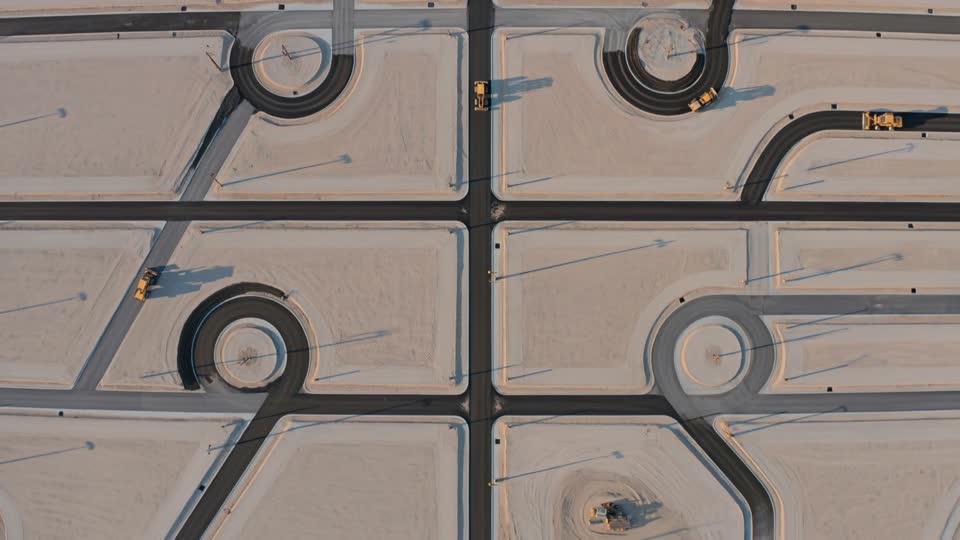
Cost guide · Sheet K-306
What does it cost to service a lot or subdivision?
A "serviced lot" has two cost layers stacked on top of each other: an off-site levy the municipality charges per hectare for growth infrastructure, and an on-site construction cost for the roads, pipes and grading inside the subdivision itself. Three Canadian cities publish the first layer in full. Nobody publishes the second as a single number, because it depends on the site.
STA 0+120Off-site levies and on-site servicing are different costs
"Servicing" a lot has two separate cost components that get quoted together and should not be confused:
- Off-site levies. A fee the municipality charges per hectare of new development to pay for growth-related infrastructure outside the subdivision boundary — the trunk sewer, the arterial road, the water treatment capacity a new area draws on. Set by bylaw, published as a rate, and non-negotiable.
- On-site servicing construction. The actual roads, watermain, sanitary and storm sewer, streetlights and grading built inside the subdivision, paid for directly by the developer's contractor and specific to that site's design.
The site servicing process guide covers the sequence from land-use approval through to acceptance; this page is about what each layer costs where the data is public.
STA 0+240Calgary: off-site levies, 2026
Calgary publishes Greenfield Area off-site levy rates by infrastructure category under Bylaw 1H2024, effective January 1, 2026:
| Category | $/ha |
|---|---|
| Transportation | 170,336 |
| Wastewater treatment | 157,407 |
| Water distribution | 90,325 |
| Wastewater collection | 76,577 |
| Recreation | 57,194 |
| Water treatment | 35,599 |
| Stormwater (citywide) | 22,803 |
| Transit buses | 21,345 |
| Emergency response | 18,591 |
| Police | 8,101 |
| Library | 6,319 |
Summed, those eleven lines total $664,597 per hectare — a figure Calgary does not publish as a single total; it is added up here from the published lines1. On top of the levy, Calgary charges a traffic signage and road markings fee of $2,054/ha and inspection fees of $2,493/ha, and the city notes the information "has no legal status" — the bylaw governs, and a 2026 rate review is underway, so treat these as current rather than fixed. Established-area (infill) development pays a different structure: $9,328 per single-detached unit for water and wastewater treatment levies, rather than a per-hectare greenfield rate.
STA 0+360Edmonton: Arterial Roadway Assessment, 2026
Edmonton's equivalent charge is the Arterial Roadway Assessment (ARA), set under the Arterial Roads for Development Bylaw:
| Item | $/ha |
|---|---|
| Core rate, residential (city-wide weighted average) | 299,963 |
| Core rate, residential (lowest catchment) | 12,953 |
| Core rate, residential (highest catchment) | 551,757 |
| Core rate, industrial (city-wide weighted average) | 120,595 |
| Land dedication, SW quadrant | 775,000 |
| Land dedication, SE / NW-West / NE quadrants | 680,000 |
2 The spread between the lowest and highest residential catchment — roughly $13,000 to $552,000 per hectare — is the single widest range in any Canadian municipal servicing charge found for this guide, and it means "the Edmonton rate" is not one number; it depends entirely on which catchment a parcel sits in. Edmonton also charges a residential servicing inspection fee of $10,455/ha plus GST, with a 3.0 ha minimum. Two Sanitary Servicing Strategy Fund charges (an expansion assessment and a trunk charge for commercial/industrial/institutional land) have been paused since May 2024 and are not currently collected.
STA 0+480Regina: development charges, 2026
Regina charges a flat greenfield development charge by land use, effective January 1, 2026: $385,585/ha for residential and commercial land, and $128,494/ha for industrial-zoned land3. Area-specific charges apply on top of that in some catchments — for example, an additional $62,447 to $100,395/ha in the NW Regional Wastewater Lift Station service area, depending on the sub-area, effective July 2025.
Saskatoon and Winnipeg were checked for an equivalent published rate and neither has one publicly available at the time of writing: Saskatoon's relevant council records sit behind a document platform that could not be accessed, and Winnipeg publishes no current per-hectare growth or impact fee. Do not assume either city's charge is similar to Calgary, Edmonton or Regina's without a direct quote from that municipality.
STA 0+600On-site servicing: what nobody publishes as one number
The roads, watermain, sanitary sewer, storm sewer and streetlights actually built inside a subdivision are priced by a contractor against a specific engineering drawing, not a published municipal rate. Each component has its own cost guide on this site: watermain and sewer, concrete for curb and sidewalk, and road construction for the street itself. Earthworks — the bulk grading, cut and fill, and subgrade preparation that comes before any pipe or pavement goes in — is priced at the excavation and site preparation cost guides, using the same Alberta highway tender rates shown in the figures above, since a subdivision's earthworks are the same category of work at a different scale.
STA 0+720What changes the number on a small or infill site
A one- or two-lot infill site and a full greenfield subdivision are priced on entirely different bases:
- Levy structure. Established-area (infill) levies are typically charged per unit or per square metre of floor area, not per hectare — Calgary's established-area water and wastewater levy is $9,328 per single-detached unit, a different calculation from the greenfield $/ha rates above.
- Existing infrastructure. An infill lot may already have a stub connection to watermain and sewer; a greenfield parcel needs the full network built from the property line to the trunk main.
- Minimum servicing standards. Municipalities set minimum pipe sizes, road widths and utility depths regardless of how small the site is, so a single lot cannot service more cheaply per unit than the standard allows.
- Engineering and inspection fees. Servicing agreement inspection fees, engineering drawings and As-Built surveys are largely fixed costs that a one-lot project cannot spread over much frontage.
STA 0+840What to send for a price
A servicing cost estimate needs, at minimum: the municipality and quadrant or catchment the land sits in (the levy rate depends on it), the zoning and proposed land use, the site area in hectares, whether municipal water and sewer already reach the property line, and any existing geotechnical or survey information. The municipality's development or planning department confirms the current levy rate directly; a civil contractor or engineer prices the on-site construction against a servicing drawing once one exists. The site servicing process guide walks through that sequence end to end.
Questions people ask
How much does it cost to service a lot?
It depends on the municipality and whether the lot is greenfield or infill. Calgary's 2026 greenfield off-site levy lines sum to $664,597/ha; Edmonton's residential Arterial Roadway Assessment ranges from about $13,000 to $552,000/ha depending on catchment; Regina charges a flat $385,585/ha for residential and commercial land. None of those figures include the on-site construction cost of the actual roads and pipes, which is priced separately by a contractor.
How much does subdivision servicing cost in Alberta or Calgary?
Calgary's 2026 greenfield off-site levy totals $664,597/ha across eleven infrastructure categories, plus inspection and signage fees. That covers off-site growth infrastructure only; on-site roads, watermain and sewer inside the subdivision are priced separately against an engineering drawing. See the Calgary table above for the category breakdown.
What does it cost to develop a subdivision or land per acre?
No single published figure covers a full subdivision per acre, because it combines an off-site levy (see the Calgary, Edmonton and Regina rates above, convertible from hectares by dividing by about 2.47) with a site-specific on-site construction cost that depends on lot count, road length and utility depth. Get separate numbers for the levy and the construction.
How much does it cost to get municipal services to land?
If the land already borders a municipal water and sewer main, the cost is largely the on-site connection and any frontage-based local improvement charge — see the watermain and sewer cost guide. If it does not, a full off-site levy and trunk extension may apply; confirm with the municipality's planning department.
Is there a lot servicing cost calculator?
Not for the full levy-plus-construction figure, since municipal levy rates vary by city and catchment and change by bylaw. Use the cut and fill and trench excavation calculators for the on-site earthworks and utility trenching volumes, and confirm the current levy rate directly with the municipality.
What is a serviced lot?
A lot with municipal water, sanitary sewer, storm drainage, a constructed road and, usually, power and gas already extended to the property line, ready to build on without the buyer having to fund that infrastructure separately. The developer who created the lot has typically already paid the off-site levy and built the on-site servicing described on this page.
Sources
- Off-site Levies, Rate Calculations 2026The City of Calgary · 2026
- 2026 ARA RatesCity of Edmonton · 2026
- Development ChargesCity of Regina · 2026
- Unit Price Averages (workbook updated 2026-06-24)Alberta Transportation and Economic Corridors · 2026
- The Daily - Canada's Core Public Infrastructure Survey: Replacement values, 2022Statistics Canada · 2022-12-31
Related
-
 K-301
Excavation cost
Per cubic metre on tendered work, per hour for equipment, and what changes the number on a small job.
K-301
Excavation cost
Per cubic metre on tendered work, per hour for equipment, and what changes the number on a small job.
-
 K-302
Cost to build a road
What a kilometre of road costs, layer by layer, from gravel lease roads to paved highway.
K-302
Cost to build a road
What a kilometre of road costs, layer by layer, from gravel lease roads to paved highway.
-
 K-303
Asphalt paving cost
Hot-mix by the tonne, paving by the square metre, and milling, overlays and parking lots.
K-303
Asphalt paving cost
Hot-mix by the tonne, paving by the square metre, and milling, overlays and parking lots.