Cost guide · Sheet K-312
How much does directional drilling cost?
No Canadian government body publishes a price per metre for horizontal directional drilling. What Alberta does publish is a paired price for trenched versus pushed (trenchless) underground electrical conduit, which is the closest official benchmark for the trenchless cost premium, even though it is not HDD pipe or fibre installation itself.
STA 0+120Why there is no published HDD price
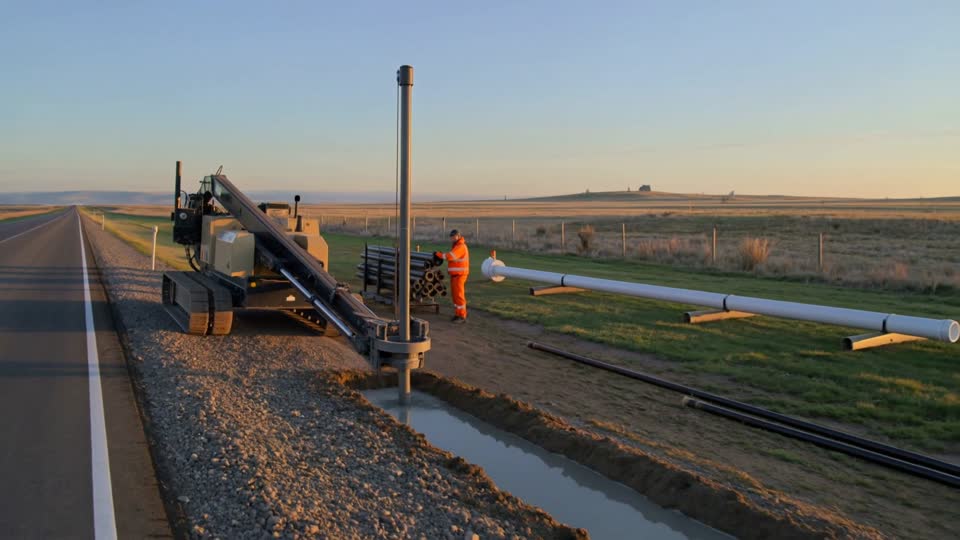
Horizontal directional drilling (HDD) is a specialized trenchless method: a pilot bore is steered underground along a planned path, then reamed and a pipe or conduit is pulled back through it, all without an open trench along the route. No provincial transportation ministry, municipality or StatCan table publishes an HDD price per metre — it is not a standard highway tender item the way excavation or asphalt are, and most HDD work in Canada is contracted directly between a pipeline, utility or telecom owner and a specialized drilling contractor, outside the public tender data this site draws on.
The closest official comparison available is Alberta's paired item for underground electrical conduit, priced both ways on the same 2026 tender list: open-cut trenched installation at $69.87 per m1 per metre, and pushed (trenchless) installation at $149.03 per m1 per metre — roughly double the trenched price for the same buried conduit. That ratio is a genuine, sourced data point about the trenchless cost premium in general, but conduit-pushing is a smaller-scale, shorter-distance method than a full HDD crossing under a river or highway, and the ratio should not be read as an HDD price itself.
STA 0+240What actually drives an HDD quote
Without a published unit price, the honest answer to "how much does directional drilling cost" is that it depends on a specific set of drivers a contractor prices directly:
- Ground conditions. Clay, sand, cobble and rock all bore differently; unexpected rock or boulders along the path is one of the most common reasons an HDD job runs over its original quote.
- Bore length and diameter. Longer, larger-diameter bores need more powerful rigs, more drilling fluid and more time.
- What is being installed. A single small conduit is a smaller pull than a large-diameter steel casing or a bundle of utilities in one bore.
- Crossing type and permits. Boring under a highway, railway or waterway usually requires the crossing owner's engineering review and permit, which adds time and sometimes design cost before drilling starts.
- Rig mobilization. HDD rigs are specialized, less common equipment than an excavator, and mobilizing one to a remote or one-off site is a significant fixed cost.
- Drilling fluid and cuttings management. The bentonite slurry used to lubricate and support the bore has to be mixed, recovered and disposed of, and a frac-out (drilling fluid escaping to the surface) can add cleanup cost and, near water, regulatory involvement.
STA 0+360Trenched versus trenchless: the one paired comparison that exists
| Item | Unit | 2026 avg | Contracts | 2025 | 2024 |
|---|---|---|---|---|---|
| Underground Electrical Conduit - Supply and Install - Trench ExcavationItem S400 | m | $69.87 | 7 | — | — |
| Underground Electrical Conduit - Supply and Install - Pushed ConduitItem S405 | m | $149.03 | 11 | — | — |
Reading this pair honestly: pushed installation costs about double the open-cut price for the same conduit on Alberta's 2026 tenders. Where open-cut excavation is actually available — no pavement, no sensitive crossing, no depth or access constraint — it remains the lower-cost method by this data. Trenchless methods earn their premium where open-cut is not a realistic option at all: under an active highway, a rail line, a river, or a stretch of mature landscaping and hardscape a client will not let a contractor dig up. See the trenchless and directional drilling discipline page for the full method comparison, including auger boring, microtunnelling and pipe bursting alongside HDD.
STA 0+480Where HDD gets used
HDD shows up across a range of scales, and the economics differ at each end of it. Large-diameter, long-distance bores install gas and oil pipelines, fibre-optic backbone routes and major watermain crossings under rivers, where the alternative — an open-cut crossing of a waterway or a multi-lane highway — is either prohibitively disruptive or not permitted at all. At the smaller end, a single residential or commercial service (a gas line, a fibre connection, or a water or sewer service) is bored under a driveway, a mature tree's root zone, or a short stretch of finished landscaping specifically to avoid the restoration cost and disruption of an open trench. The cost logic in both cases is the same — HDD earns its premium against open-cut where open-cut carries a real cost or restriction of its own — but the fixed mobilization cost of a rig makes the smaller end of that range price much higher per metre than the larger end.
STA 0+600What changes the number on a short or one-off bore
A single short crossing does not scale down cleanly from a long utility corridor bore:
- Mobilization dominates a short bore. Bringing an HDD rig, mud system and crew to site costs close to the same for a 30 m crossing as a 300 m one, so the cost per metre is far higher on a short job.
- Entry and exit pit work. Every bore needs excavated pits at each end, priced separately from the drilling itself — see the excavation cost guide.
- Standby for locates and permits. A bore path has to be cleared of conflicting utilities before drilling starts, which can mean waiting on locate requests (3 to 5 full working days' notice in Alberta2) and, for a road or rail crossing, a separate crossing-owner permit that can take longer than the drilling itself.
- Restoration. Entry and exit pits sitting in a driveway, sidewalk or road need the same restoration costs covered in the concrete and asphalt paving cost guides.
STA 0+720What to send for a quote
To get a real HDD quote rather than a guess: the crossing length and what is being crossed (road, rail, waterway, or open ground), what is being installed (pipe or conduit diameter and material), any known ground conditions or geotechnical information, and whether a crossing-owner permit is already in progress. A contractor also needs to know whether an open-cut trench is even an option for any part of the route, since a mixed trenched-and-bored approach is often the lowest-cost way to cross an obstacle without paying trenchless rates for the whole run.
Questions people ask
How much does directional drilling cost?
No Canadian government publishes an HDD price per metre. The closest official data point is Alberta's paired conduit item: pushed installation at $149.03 per m1 per metre against $69.87 per m1 for the same conduit trenched — roughly double. A real HDD quote depends on ground conditions, bore length and diameter, and permits for the specific crossing; see "What actually drives an HDD quote" above.
What is the directional drilling or boring price per foot?
No official per-foot price exists either. Convert the per-metre conduit comparison above by dividing by 3.28 for a rough sense of the trenched-versus-pushed ratio, but get a direct quote for an actual per-foot HDD price on your specific crossing.
How much does it cost to bore under a road?
It depends on the road authority's permit requirements, the bore length and depth needed to pass safely under the road structure, and ground conditions. No published price exists; the road or highway authority's crossing permit process is usually the first step before a contractor can quote the drilling itself.
How much does horizontal directional drilling or horizontal boring cost?
"Horizontal boring" sometimes refers to a smaller auger-boring method rather than HDD; both are trenchless but different in scale and equipment. Neither has a published Canadian government price. Get quotes from contractors who specialize in the specific method your crossing needs.
Where do I get directional drilling quotes?
Directly from contractors who operate HDD rigs, since no public price list exists. Prepare the crossing length, what is being installed, and any known ground conditions before asking, so quotes from different contractors are pricing the same scope.
Is trenchless installation always more expensive than trenching?
On Alberta's only published paired comparison, pushed conduit installation cost about double the trenched price. Trenchless is still frequently the right choice where open-cut is not possible at all — under pavement, rail lines or waterways — because in those cases open-cut is not a lower-cost alternative, it is not an available one.
Sources
- Unit Price Averages (workbook updated 2026-06-24)Alberta Transportation and Economic Corridors · 2026
- Notification ProcessUtility Safety Partners · retrieved 2026-09-24
Related
-
 K-301
Excavation cost
Per cubic metre on tendered work, per hour for equipment, and what changes the number on a small job.
K-301
Excavation cost
Per cubic metre on tendered work, per hour for equipment, and what changes the number on a small job.
-
 K-302
Cost to build a road
What a kilometre of road costs, layer by layer, from gravel lease roads to paved highway.
K-302
Cost to build a road
What a kilometre of road costs, layer by layer, from gravel lease roads to paved highway.
-
 K-303
Asphalt paving cost
Hot-mix by the tonne, paving by the square metre, and milling, overlays and parking lots.
K-303
Asphalt paving cost
Hot-mix by the tonne, paving by the square metre, and milling, overlays and parking lots.