Discipline · Sheet C-111
Rail construction
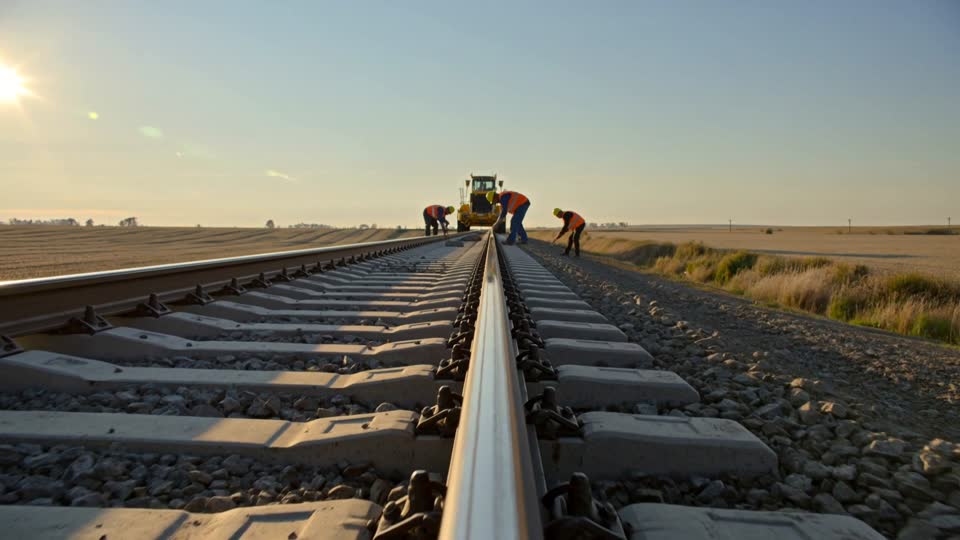
A railway is an earthworks and aggregate structure with steel on top of it: a graded roadbed, layers of ballast, ties, rail and fastenings, built and maintained to standards set by the railway that owns the line, not by a public highway specification.
Rail construction is a smaller, more specialized corner of Canadian civil work than roads or underground utilities, and most of it is not publicly tendered in the way a highway or a watermain is. Canadian National and Canadian Pacific Kansas City own and maintain the great majority of Canada's freight network as private infrastructure, transit agencies build and maintain their own light rail and commuter lines, and short lines and industrial spurs sit in between. What follows is the shape of the work, not a price list, because there is no public benchmark price for rail construction comparable to the Alberta highway averages used elsewhere on this site.
STA 0+120What rail construction covers
A railway is built in layers, much like a road, but engineered to carry point loads from steel wheels rather than a distributed tire footprint:
- Roadbed. A graded and compacted earthworks structure, built and drained much like a highway embankment; see earthworks and excavation.
- Sub-ballast. A granular layer that separates the ballast from the subgrade and helps drainage.
- Ballast. Crushed, angular rock that holds the ties in place, spreads the load and lets water drain away from the track.
- Ties and fastenings. Wood or concrete ties spaced along the track, holding the rail to gauge with spikes, clips or other fastening systems.
- Rail. Steel rail, welded into long continuous lengths on most main lines to reduce joints.
- Crossings and sidings. At-grade road crossings with their own surface and warning systems, and sidings or spurs that let trains pass or serve an industrial site.
Signals, communications and rolling stock are their own specialized systems, well outside civil construction scope, and are not covered here.
The civil earthworks and drainage that support a railway are close cousins of highway earthworks: cuts and embankments are built and compacted the same way, and keeping water away from the subgrade matters just as much, because a saturated subgrade under a railway causes the same kind of failure as it does under a road. The difference is tolerance. A highway can tolerate a certain amount of settlement and roughness; a railway's alignment and surface have to stay within tight geometric limits for trains to run safely at speed, which is part of why track work is inspected and maintained on its own continuous cycle rather than a periodic resurfacing schedule.
STA 0+240Ballast and aggregate
Ballast is a specific, tightly graded crushed rock product, chosen for hardness, angularity and resistance to breakdown under repeated loading, and it is specified and supplied by the railway or its contractor, not sold as a standard highway aggregate item. There is no public Canadian rail-ballast price index comparable to a provincial highway unit price sheet, so this page does not quote a ballast price. The closest public benchmarks are Alberta's highway aggregate and granular base items, which describe adjacent products (base course, sub-base and granular fill) rather than ballast itself:
| Item | Unit | 2026 avg | Contracts | 2025 | 2024 |
|---|---|---|---|---|---|
| Supply of Aggregate - With OptionItem A800 | t | $3.27 | 16 | — | — |
| Granular Base Course - Des. 2 Cl. 25Item B282 | t | $33.65 | 26 | $29.03 | $32.51 |
| Granular FillItem B152 | t | $40.83 | 9 | — | — |
Aggregate supply with a gradation option averaged $3.27 per t1 and granular base course (design 2, class 25) averaged $33.65 per t1 on Alberta highway contracts in 2025–26. Use these only as a general sense of how crushed rock supply prices move, not as a rail ballast quote; ballast pricing depends on the source quarry, the specification the railway sets, and the haul distance to the work site, all of which are project-specific. See aggregates and gravel for how supply, crushing and haul are generally priced.
STA 0+360Crossings and sidings
A level crossing carries a road over the track at grade, with its own crossing surface (timber, concrete panel, rubber or asphalt-filled), warning devices, and often signal and gate equipment installed and maintained under the railway's own standards and any applicable federal rail safety requirements. Building or altering a crossing typically needs the agreement of both the road authority and the railway that owns the track, because both are responsible for their side of the crossing.
Sidings and spurs are shorter sections of track that branch off a main line, used to let trains pass each other, to store cars, or to serve an industrial customer directly. They are built with the same layers as a main line but are usually a lower construction and maintenance standard because train speeds on them are lower.
STA 0+480Access and flagging near live track
Any work near an active railway, whether it is rail construction itself or a utility crossing beneath the track, needs the railway's authorization before people or equipment go near the right-of-way. In practice this means a flagging or protection agreement with the railway: a qualified flagger or the railway's own personnel control access to the track during the work, using the railway's own rules for train movements, minimum clearances and stop-work triggers. Those rules are set and enforced by the railway that owns the line, not by a public authority, so the specific clearance distances and notice periods are not summarized here; confirm them directly with the railway before planning work near track.
Not safety advice
Work near live track is inherently high-consequence. Treat this section as a summary of what to arrange, not as the rule itself, and get the railway's written protection requirements before scheduling anyone near the right-of-way.
STA 0+600Who owns and maintains rail infrastructure
Most of Canada's rail network is privately owned and maintained by the freight railways that operate on it, funded through their own capital programs rather than public infrastructure budgets. Transit agencies (light rail, commuter rail and metro systems) own and maintain their own track separately, usually funded through a mix of municipal, provincial and federal transit programs. Statistics Canada's Core Public Infrastructure Survey, which tracks the condition and replacement value of roads, bridges, water and wastewater assets across the country on a two-year cycle2, does not include rail track among its asset classes, so there is no equivalent national condition or replacement-value figure for rail comparable to the road and bridge data used on the municipal infrastructure page.
STA 0+720Tendering rail work
Because most Canadian rail infrastructure is privately owned, rail construction and maintenance contracts are typically tendered directly by the railway or transit agency rather than through the open federal tender feeds used for highways and public buildings. CanadaBuys' UNSPSC catalogue includes a code for mass transit system construction services (72141600)3, which is the closest federal category, but it does not capture private freight-railway contracting. Transit agency and provincial rail-related tenders are more often found on the agency's own procurement portal or on provincial and municipal tender portals; see the live tender feed for what is currently open.
STA 0+840What to send for a price
Because rail work is specialized and mostly privately contracted, a scope that gets a useful response usually includes:
- Whether the work is new track, a siding, a crossing, or maintenance/renewal of existing track.
- The track owner or operator, since access, flagging and specification approval run through them.
- Length of track involved, and rail weight or tie type if known from an existing design.
- Any road crossing involved, and which road authority is party to it.
- Access constraints: work windows between trains, seasonal restrictions, and any existing protection agreement with the railway.
Expect a rail scope to take longer to price than an equivalent length of road or pipe, because the track owner's approval and access arrangements usually have to be confirmed before a contractor can commit to a schedule.
Questions people ask
How is rail ballast priced in Canada?
There is no public Canadian price index for rail ballast comparable to a provincial highway unit price sheet; the railway or its contractor sets the specification and sources it from an approved quarry. Alberta highway aggregate and granular base items, such as $3.27 per t1 for supply with a gradation option, are the closest public benchmarks for crushed rock supply, not a ballast price.
Who owns the railways in Canada?
Most of the freight network is owned and maintained by Canadian National and Canadian Pacific Kansas City as private infrastructure, with short lines operating smaller regional networks. Transit agencies own and maintain their own light rail, commuter rail and metro track separately.
Does Canada track the condition of rail infrastructure the way it does roads and bridges?
Not through the same national program. Statistics Canada's Core Public Infrastructure Survey publishes condition and replacement-value data for roads, bridges, water and wastewater assets every two years2, but rail track is not one of the asset classes it covers.
Do I need the railway's permission to work near a live track?
Yes. Any work near an active railway needs a flagging or protection arrangement with the railway that owns the line, under that railway's own rules for clearances and train movements. Confirm the requirement directly with the railway before scheduling work near the right-of-way.
How do I find rail construction tenders?
Rail work is usually tendered by the railway or transit agency directly rather than through the general federal tender feed, since most Canadian rail infrastructure is privately owned. Check the agency's own procurement portal, provincial tender portals, and the site's tender feed.
Sources
- Unit Price Averages (workbook updated 2026-06-24)Alberta Transportation and Economic Corridors · 2026
- Canada's Core Public Infrastructure surveyHousing, Infrastructure and Communities Canada · retrieved 2026-09-24
- Mapping of GSIN-UNSPSC (CSV)Public Services and Procurement Canada · file dated 2021-05-12
Related
-
 C-101
Earthworks & excavation
Stripping, bulk excavation, cut and fill, rock, compaction and the volumes that drive every estimate.
C-101
Earthworks & excavation
Stripping, bulk excavation, cut and fill, rock, compaction and the volumes that drive every estimate.
-
 C-102
Site servicing & land development
Water, sewer, storm and roads for new lots, and the agreements, levies and sequence that come with them.
C-102
Site servicing & land development
Water, sewer, storm and roads for new lots, and the agreements, levies and sequence that come with them.
-
 C-103
Underground utilities
Watermain, sanitary and storm sewer, manholes and services, from trench design to testing.
C-103
Underground utilities
Watermain, sanitary and storm sewer, manholes and services, from trench design to testing.