Cost guide · Sheet K-313
How much does hydrovac cost?
Hydrovac excavation has no published hourly rate anywhere in Canada. It is a specialized, privately quoted service, and the honest way to answer "how much does hydrovac cost" is to explain what drives the number and why the method gets specified in the first place.
STA 0+120Why there is no published hydrovac rate
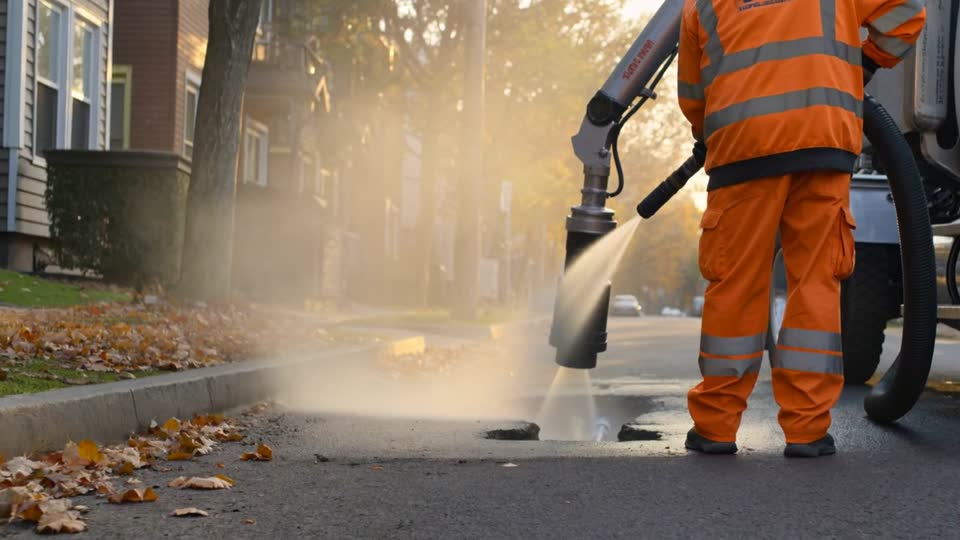
No provincial government, municipality or StatCan table publishes an hourly, daily or per-metre hydrovac rate. Hydrovac (hydro excavation) uses pressurized water to break up soil and a vacuum to remove it into a tank, a non-destructive method used specifically where digging mechanically would risk damaging what is underground. It is not a tendered highway pay item the way mechanical excavation is, and almost all hydrovac work in Canada is billed directly by private operators on an hourly or day-rate basis that is not captured in any public tender dataset this site draws on.
That absence is itself informative: unlike excavation, asphalt or gravel, there is no government body anywhere that tenders hydrovac work at a scale that produces a bid average. It is a specialty trade service, priced like one.
STA 0+240Why hydrovac gets specified at all
Hydrovac costs more per cubic metre than mechanical excavation, and it is often required rather than chosen, for regulatory reasons. In Alberta, mechanical excavation is not permitted within 600 mm of a buried pipeline without the pipeline owner's representative directly supervising1, which is exactly the zone hydrovac is built to work in safely. Before any of that, ground has to be located: Alberta requires 3 to 5 full working days' notice for a locate request before ground disturbance2, and the coloured paint and flags that come back follow a national colour code — red for power, yellow for gas, blue for water, green for sewer3333 — that a hydrovac crew works around, exposing (daylighting) each marked utility by hand-safe vacuum excavation rather than digging blind with a bucket. See call before you dig for the full locate process this depends on.
STA 0+360What actually drives a hydrovac quote
Without a published rate, a hydrovac quote is built from:
- Truck size and type. A tandem-axle vac truck has a smaller tank and reach than a tri-axle unit; larger trucks cost more per hour but empty less often.
- Disposal of spoil. The water-and-soil slurry has to be trucked to a disposal facility and dumped for a fee; a job far from an approved disposal site spends more time and cost per load hauling and dumping than digging.
- Depth and soil type. Dense clay or frozen ground takes longer to break up with water than loose sand or loam, directly extending the billed hours for the same excavation volume.
- Water supply. Trucks either start full or need to refill from a hydrant or water source partway through a job, which adds non-productive time.
- Season. Winter hydrovac work needs heated water and antifreeze measures to keep the system from freezing, and frozen ground itself takes longer to break up — both add cost in cold months.
- Standby and minimum callout. As with any specialty equipment, most operators set a minimum billed period regardless of how little material actually needs to be exposed.
STA 0+480What changes the number on a small job
A single utility locate-and-expose job is not priced the same way as a full day of production hydrovacking on a larger site:
- Mobilization and travel time. Many operators bill portal-to-portal, so a site far from the truck's base adds cost before any digging starts.
- Minimum hours. A half-hour job to expose one utility crossing often still gets billed a minimum call-out, commonly two to four hours in the private market, though no official figure exists to confirm a standard.
- After-hours and emergency work. A hydrovac called out to expose a struck or suspect line outside normal hours typically carries a premium rate, again privately set.
- Number of exposures. Each separate utility crossing that needs to be daylighted adds setup time distinct from the volume of material moved.
STA 0+600Hydrovac versus mechanical excavation
Mechanical excavation averaged $11.20 per m³4 per cubic metre on Alberta's 2026 highway tenders — a genuine benchmark for what digging costs when a bucket can be used freely. Hydrovac costs more per cubic metre than that in virtually every private quote, because it is slower (water and vacuum move less material per hour than a bucket) and uses specialized equipment. The comparison only matters where a real choice exists: within a locate-restricted zone, near a pressurized or fragile utility, or where a client specifically wants a non-destructive method, mechanical excavation is not a lower-cost alternative, it is not an available one, and the comparison to the excavation cost guide above is informative rather than a way to negotiate the price down.
STA 0+720When hydrovac pays for itself
Even where mechanical excavation is technically allowed, hydrovac is often the more sensible choice on cost grounds, not just a regulatory requirement. A struck gas or fibre line from a mechanical excavator can cost far more in emergency repairs, service outages and potential liability than the hourly premium hydrovac carries, and the risk rises with every utility crossing a dig has to pass. On projects with dense, congested or poorly documented underground infrastructure — an older urban block, for example — hydrovac's slower pace per cubic metre is frequently offset by not having to stop and remediate a hit line partway through the job.
STA 0+840What to send for a quote
For a comparable hydrovac quote: the number and depth of utilities to be exposed, what locates have already been requested and marked, soil type if known, site access for a vac truck, the nearest approved disposal site, and the season. Confirm whether the quote is hourly, per truck-load, or a flat rate for the scope, and what the minimum billed period is.
Questions people ask
How much does hydrovac cost per hour?
No official hourly rate is published anywhere in Canada. Hydrovac is billed privately and depends on truck size, soil conditions, disposal distance and season. Get quotes from two or three operators for the same scope rather than comparing against a benchmark that does not exist.
What are hydrovac rates in Alberta or Calgary?
How much does hydrovac cost per day?
No official day rate exists. A day rate is a private commercial quote built from the drivers in "What actually drives a hydrovac quote" above; ask an operator for a day-rate quote against your specific scope, soil conditions and disposal distance.
What are typical hydrovac hourly rates or truck costs?
No government source publishes them. Rates vary by truck size, region, season and disposal distance, and are set independently by each operator. This guide does not publish a figure because none exists to source.
How do I get a hydrovac quote?
Contact a hydrovac operator directly with the number of utilities to expose, soil type if known, site access, and the nearest disposal facility. There is no public rate card to check a quote against, so getting more than one quote for the same scope is the most reliable way to judge whether a price is reasonable.
Why is hydrovac more expensive than regular excavation?
It moves less material per hour than a mechanical excavator and uses specialized, less common equipment, but it is specified because mechanical digging is restricted or unsafe in the conditions it is used for — commonly within 600 mm of a buried pipeline in Alberta1 or near other pressurized or fragile utilities. See "Hydrovac versus mechanical excavation" above.
Sources
- Alberta OHS Code (Alta Reg 191/2021), Part 32 Excavating and TunnellingGovernment of Alberta (OHS legislation search) · retrieved 2026-09-24
- Notification ProcessUtility Safety Partners · retrieved 2026-09-24
- CCGA Best Practices Version 3.0 (October 2018), uniform colour code (page 41)Canadian Common Ground Alliance · Best Practices v3.0, Oct 2018 (a v5.0 was reported released in 2024; not checked)
- Unit Price Averages (workbook updated 2026-06-24)Alberta Transportation and Economic Corridors · 2026
Related
-
 K-301
Excavation cost
Per cubic metre on tendered work, per hour for equipment, and what changes the number on a small job.
K-301
Excavation cost
Per cubic metre on tendered work, per hour for equipment, and what changes the number on a small job.
-
 K-302
Cost to build a road
What a kilometre of road costs, layer by layer, from gravel lease roads to paved highway.
K-302
Cost to build a road
What a kilometre of road costs, layer by layer, from gravel lease roads to paved highway.
-
 K-303
Asphalt paving cost
Hot-mix by the tonne, paving by the square metre, and milling, overlays and parking lots.
K-303
Asphalt paving cost
Hot-mix by the tonne, paving by the square metre, and milling, overlays and parking lots.